On this page
The checklist before you cut anything
Before the backstory, the working list I actually give clients:
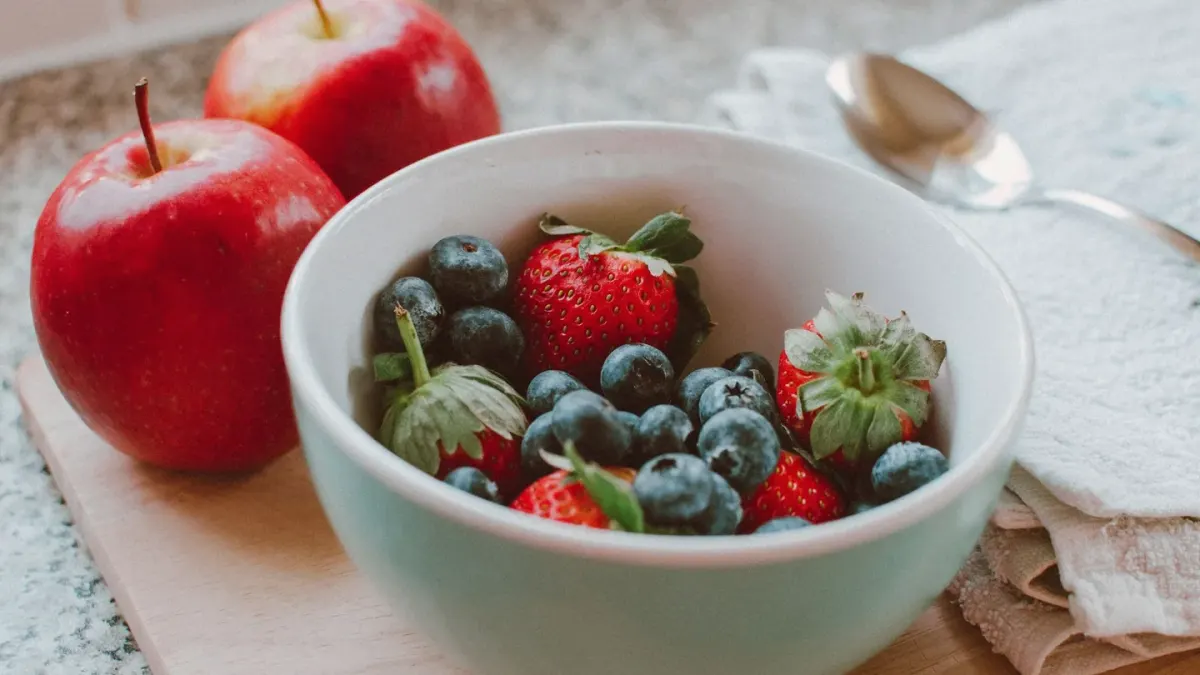
- Safe, most dogs, most days in small amounts: blueberries, apples (no seeds/core), bananas, watermelon (no rind/seeds), carrots, green beans, pumpkin, celery, cucumber.
- Safe but portion-sensitive: peas, broccoli in small florets — see Can Dogs Eat Broccoli? The Portion Math That Actually Matters for the gas-and-goitrogen math.
- Never, no exception: grapes, raisins, onions, garlic, leeks, chives.
- Prep matters as much as the item: wash, remove seeds/pits/stems, cut to a size that won’t choke, introduce new items one at a time.
- Cap it: treats, produce included, should stay a minor slice of daily calories — not a meal replacement.
That’s the whole verdict in five lines. The rest of this piece is why those lines are drawn where they are, because “just a little fruit” and “a little of the wrong vegetable” are not the same sentence.
Why the yes list is longer than the no list, and that’s the trap
In my practice, the dogs I worry about aren’t the ones who ate a stray blueberry off the kitchen floor — they’re the ones whose owners decided, reasonably, that if carrots are fine, more produce must be finer. I had a twelve-year-old beagle mix, a stocky little dog who’d started slowing down on stairs, come in because his owner had shifted nearly a third of his meals to steamed vegetables and fruit over about six weeks, trying to help his joints and trim some weight. His stool had gone loose, his weight had actually dropped faster than intended, and his coat had lost some shine. Nothing toxic was in the mix — carrots, green beans, a little apple — but the diet had quietly become unbalanced, low in the fat and protein a senior dog on a joint-support plan still needs. We didn’t treat this as an emergency. We rebuilt the ratio: produce back down to a supplemental role, his base diet doing the nutritional work. Within a few weeks his stool firmed up and his energy came back on the stairs.
That’s the real risk with the safe list: not poisoning, but displacement. Most fruits and vegetables that are fine for dogs are fine specifically as a small addition, not as a substitute for a complete diet.
The list that matters more: what to never offer
Toxicity is where the strict list earns its keep. The ASPCA notes that grapes and raisins can cause kidney failure in dogs through a mechanism that’s still not fully understood, and no amount has been established as safe — this isn’t a portion problem, it’s a category problem. Onions and garlic work differently: the ASPCA explains they contain compounds that damage a dog’s red blood cells, impairing the blood’s ability to carry oxygen, and onion powder carries the same risk as the fresh vegetable, so a broth or sauce with onion in it counts. Leeks and chives belong in that same family and get the same answer: no.
This is where I part ways with the “everything in moderation” instinct some owners bring in. Moderation is the right frame for pumpkin or green beans. It is the wrong frame for onions and grapes, where the correct dose is zero, and I’d rather an owner over-restrict than test the boundary.
Where the evidence is strong versus where it’s just tradition
Some of the produce owners reach for has real structure/function grounding, not just folk wisdom. Pumpkin is the clearest example in my own recommendations: pumpkin fiber is a gentle, natural source of both soluble and insoluble fiber, which is why it shows up so often for dogs with loose stool or mild constipation. That’s a legitimate, evidence-backed reason to keep a can of plain pumpkin in the pantry — not a cure for anything, but a genuinely useful fiber source.
Fiber more broadly deserves a second look, because a lot of what owners are actually managing when they add vegetables is digestive tone, and that’s a place where the gut microbiome does real work: a balanced gut microbiome supports overall immune function, which is part of why fiber-rich produce and probiotic support get paired so often in senior-dog plans. For dogs with more serious digestive disease, the stakes are different — exocrine pancreatic insufficiency, for instance, is treated with pancreatic enzyme replacement therapy, nutritional management using low-residue diets with moderate fat content, and cobalamin supplementation, not with produce swaps, and JAVMA researchers still note that future studies are needed to understand why some of these dogs develop persistent dysbiosis even after enzyme therapy starts. If your dog has a diagnosed digestive condition, fruits and vegetables are a garnish on the actual treatment plan, not a substitute for it.
Probiotic response, for what it’s worth, isn’t predicted well by how diverse a dog’s gut microbiome looks on paper — one recent trial in Frontiers in Veterinary Science found that diversity metrics did not distinguish non-responders from responders, which is a useful humility check against assuming more microbial variety automatically means better digestion. The AKC echoes the general shape of the safe list I use in the clinic — apples, bananas, blueberries, watermelon, carrots, celery, and green beans among the commonly recommended options — while noting that seeds, pits, stems, and tough rinds should come off before anything hits the bowl.
A practical sequence for adding produce without overthinking it
Start with one item, a small amount, and a few days of watching stool and appetite before adding a second. Blueberries or a few green beans are a reasonable first choice for most dogs because reactions are rare and the pieces are naturally bite-sized. Skip the onion-garlic family entirely rather than testing tolerance — the downside there isn’t gas, it’s red blood cell damage. If your dog has a known digestive condition, ask your veterinarian before adding fiber-heavy produce, since the fiber that helps a healthy gut can complicate an already inflamed one. And if you’re drawn to produce because a specific fruit worries you — apples for the seeds, avocado for the pit, bananas for the sugar — the species-specific guides are more useful than a general list: see Can Dogs Eat Apples?, Can Dogs Eat Avocado Safely?, and Can Dogs Eat Bananas? for the details particular to each.

The bottom line
The dogs I see get into trouble with produce almost never got there through a single dramatic mistake — a grape here, a garlicky scrap there. The more common pattern, like the beagle mix on stairs, is a slow drift where “healthy” additions crowd out a balanced base diet. Keep the safe list as a supplement, keep the no list absolute, and match the amount to your dog’s actual size and health status rather than to how virtuous the ingredient sounds. That’s the whole judgment call, and it’s one worth making deliberately rather than by accumulation.

Frequently asked questions
Can dogs eat grapes if it's just one or two?
No. The ASPCA notes that grapes and raisins can cause kidney failure in dogs and no amount has been proven safe, so there's no "small enough" portion to test.
Are onions and garlic dangerous even in cooked food like broth?
Yes. Onion powder carries the same risk as the fresh vegetable, so any dish made with onion or garlic — cooked, powdered, or raw — should be kept away from dogs.
How much fruit or vegetable is too much in a day?
There's no single number that fits every dog, but produce should stay a small supplement to a complete diet rather than displace core meals, since that's where nutritional imbalance tends to start.
Sources
- People Foods to Avoid Feeding Your Pets — ASPCA
- Fruits and Vegetables Dogs Can or Can't Eat — AKC
- EPI treatment and dysbiosis in dogs — JAVMA
- Probiotic responder diversity metrics in dogs — Frontiers in Veterinary Science