
On this page
A Boston terrier named Gus taught me the difference between these two ingredients faster than any textbook did.
His owner had already tried pumpkin for four days straight, a tablespoon over kibble at every meal, and the stool had gone from liquid to soft-serve and stalled there. Gus was seven, thirty-one pounds, otherwise bright and eating fine — no blood, no vomiting, no weight loss. When I ran through the differential, nothing pointed to parasites or diet indiscretion. What I suspected instead was a gut lining still irritated under a stool that fiber alone hadn’t finished normalizing. We added slippery elm bark for five days on top of the pumpkin, and the stool firmed the rest of the way by day three. That sequence — fiber first, demulcent second, in that order — is the pattern I now reach for by default.
The myth: they’re interchangeable “natural” fixes
Owners tend to treat slippery elm and pumpkin as two versions of the same home remedy, grab whichever is in the pantry or the supplement drawer. They aren’t doing the same job. Pumpkin is a fiber source; slippery elm is a mucilage. One changes stool water content through bulk and fermentation. The other coats and soothes irritated gut lining. Confusing the two means owners often reach for fiber when the real problem is a raw, inflamed mucosa — or reach for a demulcent when what’s actually needed is more bulking agent in the colon.
What pumpkin is actually doing in the gut
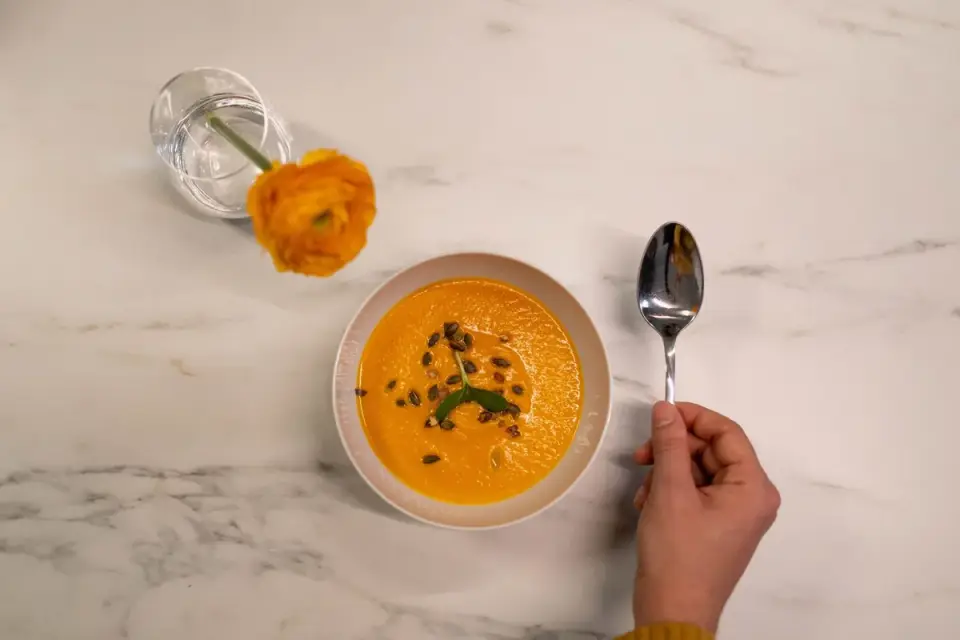
Canned pumpkin is roughly 60% soluble fiber, and soluble fiber absorbs water in the intestinal lumen, which slows transit and firms stool consistency. It also ferments into short-chain fatty acids that feed colonocytes, which is the prebiotic angle owners hear about online, per AKC. The best supporting data isn’t on pumpkin itself but on psyllium, a comparable soluble fiber: in a BMC Veterinary Research trial of police working dogs with chronic idiopathic large-bowel diarrhea, four tablespoons of psyllium husk daily for a month produced a “very good” response in half the dogs and a “good” response in another 40%, with defecation frequency dropping and stool consistency normalizing in the large majority of animals. That’s the mechanism pumpkin is riding on — it’s just a weaker, less concentrated version of the same soluble-fiber effect. If you want the actual dosing math behind canned versus powdered pumpkin, I’ve walked through it separately in Canned Pumpkin vs. Pumpkin Powder for Dog Diarrhea: What the Fiber Math Actually Says.
What slippery elm is actually doing
Slippery elm bark contains mucilage — a polysaccharide gel that forms when it contacts water — and that gel physically coats mucosal surfaces. It’s the mechanism behind the ingredient’s oldest recognized use: the FDA’s OTC monograph lists slippery elm inner bark as a demulcent for irritated mucous membranes, one of the few herbal ingredients with that kind of dedicated regulatory recognition, according to the NCBI Bookshelf LiverTox entry. In practice, that means slippery elm is doing something structurally different from fiber — it’s not bulking the stool, it’s protecting the tissue the stool is moving across. Memorial Sloan Kettering Cancer Center is direct about where the human evidence stands, though: outside a small formulation study in constipation-predominant IBS, dedicated diarrhea trial data is thin, and MSKCC states plainly that evidence for diarrhea specifically “is lacking.” I treat slippery elm as a tissue-support tool with a mechanistic case, not a stool-firming tool with trial data behind it.
Here’s the piece owners consistently miss: a mucilage that coats mucosa isn’t the same lever as a fiber that pulls water out of stool, and a dog with straightforward dietary-indiscretion diarrhea usually needs the second, not the first.
A pattern I’ve watched repeat in exam rooms
I’ve seen this split most clearly in dogs recovering from a single dietary indiscretion event — the trash-raiding Labrador, the counter-surfing terrier — versus dogs with a more chronic, low-grade loose stool that flares with stress or diet changes. The trash-raiders almost always respond to pumpkin alone within two to three days, because the underlying issue is transient osmotic overload that fiber corrects on its own. The chronic flarers are the ones where I add slippery elm, because by the time they’re four or five days into loose stool, the colonic lining itself is often irritated enough that bulking fiber alone stalls out, the way it did with Gus. One of the recurring things owners tell me in that second group is that pumpkin “worked at first, then plateaued” — that plateau is usually the signal to layer in a demulcent rather than increase the pumpkin dose further, which mostly just adds volume without addressing the irritation underneath it.
The counterargument, and why I still land where I do
The fair pushback is that pumpkin is cheap, familiar, and has real physiologic backing through the fiber-response data, while slippery elm’s diarrhea-specific evidence is genuinely sparse — MSKCC says so directly, and I’m not going to pretend otherwise. If you can only pick one ingredient to keep in the house, pumpkin is the defensible default. But “which one has better trial data” and “which one is doing the job the dog actually needs” aren’t always the same question. For a dog with an irritated colon rather than a simple water-balance problem, mucilage is solving a different piece of the physiology, and no amount of additional soluble fiber substitutes for that coating effect. I don’t reach for slippery elm as a first move; I reach for it when pumpkin has stalled or when stool has mucus or straining that points to lower-GI irritation specifically.
A practical sequence
Start with plain canned pumpkin, not pie filling, at a modest amount mixed into a normal meal, and give it 48 hours before judging it. If stool is trending firmer, keep going. If it’s flat or stalls at soft-serve, that’s the point to add a slippery elm product — powder, capsule, or liquid tincture — rather than escalate the pumpkin dose. Form matters here more than owners expect, since a mucilage needs proper hydration to gel; I’ve broken down how chew, powder, and liquid formats behave differently for supplements generally in Chew vs Powder vs Liquid Supplements for Dogs: Which Form Is Most Effective. Watch for blood, black tarry stool, vomiting, lethargy, or diarrhea past 48 hours — any of those bypasses both ingredients and goes straight to the vet. And if you’re still deciding between canned and powdered pumpkin for the fiber side of this, I covered the practical differences in Canned Pumpkin vs. Pumpkin Powder for Dog Digestion: Which One Actually Works?
I think about this the same way I think about any two-axis physiologic problem — water balance and tissue irritation aren’t the same axis, and treating them like one is how owners end up stuck at soft-serve for a week. The dogs I’ve watched recover fastest are the ones where the owner matched the tool to the actual mechanism instead of defaulting to whichever ingredient was already in the cabinet. Gus was back to normal stool by day five of that combined approach, and his owner has kept both on hand since — pumpkin for the routine trash-can afternoons, slippery elm held in reserve for when the stool tells her it’s something more than a water-balance problem.
Where this lands
Pumpkin is the correct first move for most acute, uncomplicated diarrhea because the soluble-fiber mechanism has real supporting data behind it. Slippery elm is the correct second move when stool has stalled, or when mucus and straining suggest mucosal irritation rather than a simple water-balance issue — understanding that its diarrhea-specific evidence is thinner and the case for it rests more on mechanism than trial data. Used in the wrong order, or as substitutes for each other, both usually underperform.
Frequently asked questions
Can I give my dog slippery elm and pumpkin at the same time?
Yes — they work through different mechanisms, so combining a modest amount of canned pumpkin with a slippery elm product is a reasonable approach for stool that has plateaued on fiber alone. Space them from other medications by a couple of hours since mucilage can slow absorption.
How long should I try pumpkin before switching to slippery elm?
Give plain canned pumpkin about 48 hours. If stool consistency is improving, continue; if it's flat or stalled at soft-serve, that's a reasonable point to add slippery elm rather than increase the pumpkin amount further.
When does diarrhea stop being a home-remedy situation?
Blood in the stool, black tarry stool, repeated vomiting, lethargy, or diarrhea lasting more than 48 hours should go to a veterinarian rather than another round of pumpkin or slippery elm.
Sources
- The use of soluble fibre for the management of chronic idiopathic large-bowel diarrhoea in police working dogs — BMC Veterinary Research
- Can Pumpkin Help With Dog Diarrhea? — AKC
- Slippery Elm — Memorial Sloan Kettering Cancer Center
- Slippery Elm - LiverTox — NCBI Bookshelf