
On this page
My verdict, up front: plain, air-popped popcorn, unsalted and unbuttered, is a fine occasional snack for most healthy adult dogs. The version sitting in your bowl at movie night, though, salted, buttered, maybe drizzled with caramel, is a different food entirely, and that’s usually the one causing the problem people are actually worried about.
Picture a lab mix stationed at the edge of the couch during a family movie, catching kernels tossed her way, tail going, everyone laughing, until someone notices three or four kernels never got chewed, just gulped whole. That’s the moment the conversation shifts from “is popcorn okay” to “did she just swallow something dangerous.” Most of the time the dog is fine. But the scene captures the real split in this topic: the popped kernel itself is nearly a non-event nutritionally and medically, while the unpopped ones and the toppings are where an evening can go sideways. It’s the kind of ordinary household moment that shapes how I answer this question in an exam room far more than any single ingredient chart does.
The kernel gets blamed for what the toppings actually do
Here’s where I want to correct a common myth: owners often treat popcorn as uniformly risky, as if the food itself is the hazard. It isn’t, mechanically. A popped kernel is mostly airy starch with a little insoluble fiber. It isn’t toxic, and in small amounts it won’t derail a healthy dog’s digestion. What does the damage is what’s added to it. Butter and oil are concentrated fat, and a high-fat load is one of the more consistently cited triggers for pancreatitis in dogs prone to it, even a modest amount can be enough in a susceptible dog. Salt is the other repeat offender: enough of it can cause vomiting, diarrhea, excess thirst and urination, and in extreme cases sodium ion poisoning, particularly in small dogs. So the honest framing isn’t “popcorn: yes or no.” It’s “popcorn: plain or dressed,” and only one of those two versions belongs anywhere near a dog bowl.
Seasonings compound the problem. Garlic and onion powder, both common on flavored popcorn, are genuinely toxic to dogs regardless of quantity, and they’re easy to miss on a bag’s ingredient list. If you can’t verify a bagged popcorn is plain, treat it as off-limits.
The kernel that didn’t pop is the one to worry about
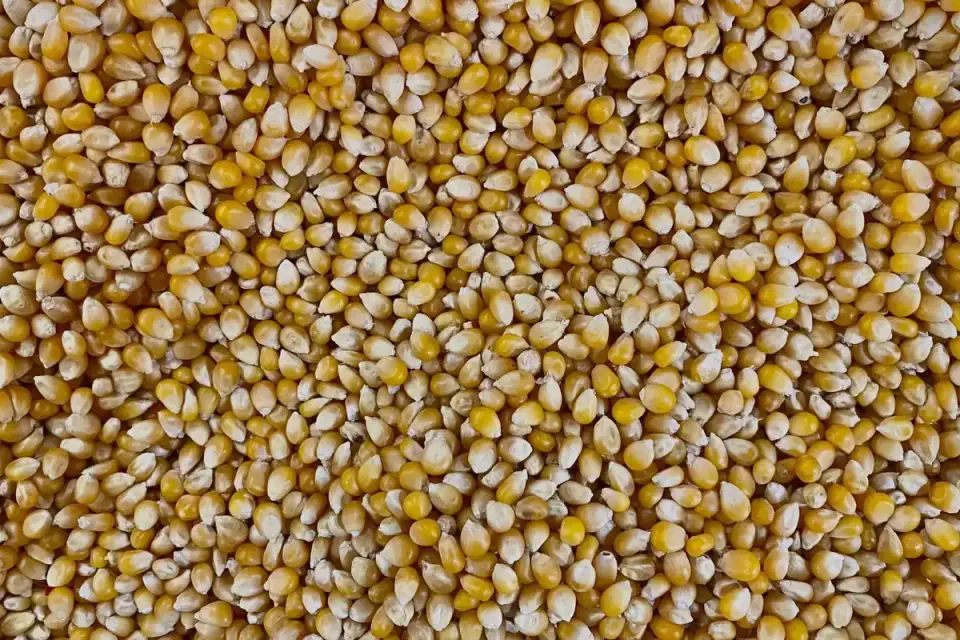
Unpopped and partially popped kernels are a mechanical hazard, not a chemical one, and they deserve more attention than the seasoning conversation usually gets. They’re hard, irregularly shaped, and just large enough to wedge between teeth or lodge in the throat or intestine. According to the American Kennel Club, kernels can get stuck in a dog’s teeth or cause choking and intestinal blockage, and small dogs, Chihuahuas and other toy breeds especially, are more vulnerable to a single swallowed kernel becoming a real problem. If your dog is gagging, drooling excessively, pawing at the mouth, or repeatedly swallowing after eating popcorn, that’s not a wait-and-see situation.
A family working through a bag of kettle corn on a Friday night is a different scenario from the same family popping a plain batch at home, even though both look like “dog eating popcorn” from across the room. The first bag carries oil, sugar, and salt in amounts built for a person’s palate, not a twenty-pound dog’s kidneys and pancreas. The second is close to inert. Reading the bag, or better, skipping the bag and using an air popper, does more to change the actual risk than any rule about quantity.
Who should skip it, and why
A handful of plain popcorn is a reasonable ask for most dogs. It is not a reasonable ask for every dog. Dogs with a history of pancreatitis or with exocrine pancreatic insufficiency (EPI) need tightly managed, low-residue, moderate-fat diets. JAVMA notes that EPI is treated with pancreatic enzyme replacement therapy, nutritional management using low-residue diets with moderate fat content, and cobalamin supplementation, which leaves very little room for an ad hoc snack, plain or not. Dogs already managing a food-sensitive gut are also worth a second thought here. If your dog’s care plan already includes something like a probiotic chew for digestive support, adding an unfamiliar snack on top isn’t the move; a stable microbiome doesn’t need extra variables. Research on probiotic response in dogs found that diversity metrics did not distinguish which dogs responded to supplementation from which didn’t, per the Frontiers in Veterinary Science study, a reminder that gut responses are individual and a snack that’s fine for one dog isn’t automatically fine for the next.
Corn allergy itself is a separate, smaller concern. True food allergy affects a minority of dogs overall, and corn ranks well behind animal proteins like beef, chicken, and dairy as a trigger, per the Merck Veterinary Manual. If your dog has a diagnosed corn sensitivity, popcorn is an easy one to cross off the list. For everyone else, it isn’t the allergy risk owners tend to assume it is.
A practical sequence for offering it
Air-pop it yourself if you can, no oil, no butter, no salt. Pick through the bowl before it reaches the floor or the dog, since stray kernels are exactly the piece that causes trouble. Offer a small handful, not a fistful, and watch the first bite go down before handing over more. If your dog already eats a fiber-forward diet, the same logic that applies when deciding how much sweet potato is reasonable for a given life stage, or where the ceiling on total daily fiber actually sits, popcorn should count against that daily total, not sit outside it. It’s a treat, not a food group, and it earns a small slice of the day’s calories at most.
Plain popcorn, in small quantities, for a healthy dog with no pancreatic or GI history, is reasonable. Anything else on that bowl, or any dog outside that description, deserves more caution than a movie night usually allows for.
Bottom line: the popped kernel is the least of your worries. Watch the butter, watch the salt, and watch the bottom of the bowl.
Frequently asked questions
Can dogs eat popcorn every day?
I wouldn't make it a daily habit. Popcorn has almost no nutritional value for a dog and, even plain, it adds empty calories on top of a complete diet. Save it for movie-night handfuls, not a regular topper.
What if my dog swallows an unpopped kernel?
Watch for gagging, drooling, repeated swallowing, or reluctance to eat. A single kernel usually passes without issue in a medium or large dog, but small breeds and any dog showing distress should see a veterinarian promptly, since kernels can lodge in the airway or intestine, according to the American Kennel Club.
Is caramel or kettle corn ever okay?
No. The sugar load in caramel corn and the salt-and-oil combination in kettle corn both push past what's reasonable for a dog's size, and either can trigger GI upset in a sensitive dog.
Does popcorn count as a good fiber source for dogs?
Not really. It has some insoluble fiber, but not in a form or dose worth relying on. If you're looking for a fiber source with a defensible track record, that's a different conversation than movie snacks.
Sources
- Can Dogs Eat Popcorn? — American Kennel Club
- Cutaneous Food Allergy in Animals — Merck Veterinary Manual
- Diagnosis and Management of Exocrine Pancreatic Insufficiency in Dogs — JAVMA
- Probiotic Response and Gut Microbiome Diversity in Dogs — Frontiers in Veterinary Science