
On this page
- The limitation nobody mentions: calm isn’t the absence of excitement
- Myth versus reality: why “calm down” doesn’t work as an instruction
- Reading the reality: what a genuinely calm dog looks like
- The sequence I actually walk owners through
- Where calming support genuinely fits, and where it doesn’t
- The bottom line
The first dog I ever coached through this was a fourteen-month-old golden retriever named Wexler, sixty-eight pounds, who could not lie down in the kitchen without vibrating. His owners fed him the second he looked calm — except “calm” for Wexler meant sitting bolt upright, ears forward, waiting. They were rewarding vigilance and calling it settling. It took us about three weeks of deliberately marking the moment his hips actually dropped to the floor and his weight shifted onto one hip before he started offering it on his own, first in the kitchen, then at the door, then in the car.
The limitation nobody mentions: calm isn’t the absence of excitement
Most owners think a calm dog is just a tired dog, or a dog who’s finally stopped asking for something. That’s the myth. In practice, a dog who’s crashed out from exhaustion hasn’t learned anything — the next time arousal climbs, he’ll do the exact same thing that got him there. What you’re actually training is a behavior: a specific posture, a specific choice, made in the presence of a trigger, that you can reward and repeat. That distinction is the whole guide.
Myth versus reality: why “calm down” doesn’t work as an instruction
The myth is that calm is achievable through correction — a firm “no,” a leash pop, a spray bottle. The reality is that punishing arousal usually just suppresses the visible signal while the internal state stays elevated, and you lose your best information about what the dog is actually feeling. What works instead is catching and rewarding the calm behavior you want to see more of: four paws still, a loose jaw, a settled sternum, a dog who chooses to lie down near the chaos instead of joining it. You’re not extinguishing excitement. You’re building a competing, reinforced habit.
Reading the reality: what a genuinely calm dog looks like
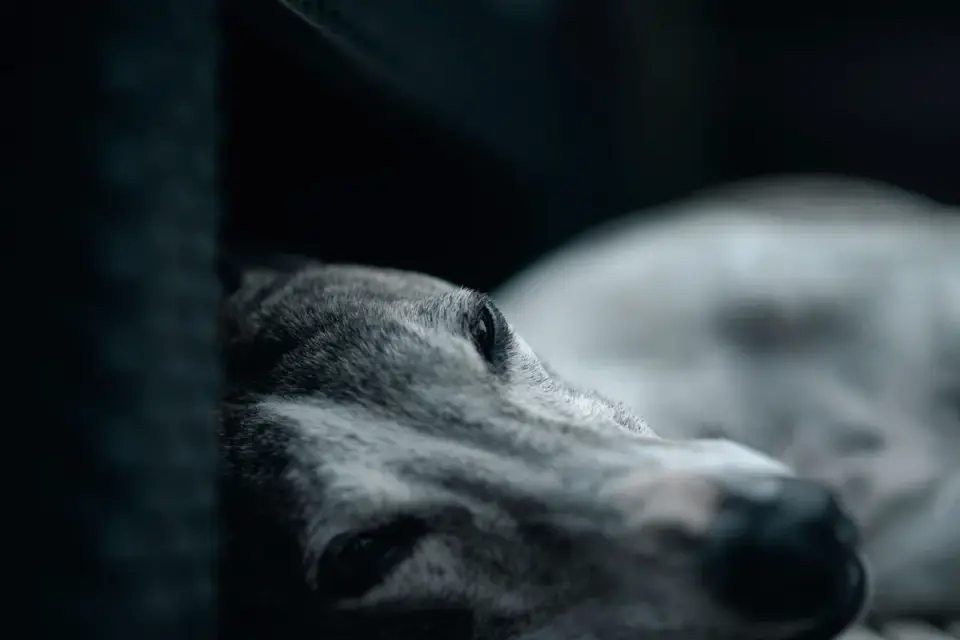
Before you can reward it, you have to recognize it. A dog offering real calm usually shows a soft mouth, blinking rather than a fixed stare, weight distributed low and loose rather than braced, and a tail carried at a neutral height instead of stiff or tucked. Compare that to a dog who has simply stopped moving because he’s overwhelmed — shut down, not settled. The second pattern is easy to mistake for progress and it isn’t. This is one of the more common mix-ups I see, alongside the related question of whether a dog is chewing out of boredom or anxiety — the surface behavior looks similar, but the underlying state, and the fix, are not.
I worked with a nine-year-old border collie mix, Piper, whose owner was convinced she’d finally cracked her dog’s door-greeting problem because Piper had started standing frozen and silent when guests arrived instead of spinning and barking. It looked like calm. It wasn’t — it was a dog holding her breath. We backed the training up to a lower-intensity version of the trigger, a knock from a family member instead of a stranger at the door, and rewarded loose, movement-based calm — a sit with a wagging tail, a glance back at her owner — rather than stillness alone. Within about six weeks, real guests got the same loose sit instead of the freeze.
The sequence I actually walk owners through
Start below threshold. Whatever triggers your dog — the leash coming off the hook, a knock, another dog across the street — find the distance or intensity at which your dog can still think, and reward calm postures there first. Mark the instant, not the aftermath: a “yes” or a click the second the sit happens, the second the down happens, the second the pacing stops. Raise criteria slowly, asking for a beat longer of stillness before the reward each time. Reward in place, delivering the treat to the dog rather than calling him toward you, so getting up isn’t inadvertently reinforced. And practice the behavior in low-arousal moments — a boring Tuesday afternoon — long before you need it at the door on Thanksgiving.
Owners sometimes ask whether this overlaps with resource guarding or excitement-based behaviors that look adjacent, like humping that reads as excitement rather than dominance, or reactivity at a window or fence that resembles barrier frustration more than aggression. The training mechanic is the same in each case: identify the threshold, reward the alternative behavior, raise criteria gradually.
Where calming support genuinely fits, and where it doesn’t
A common question is whether a supplement can shortcut this process. It can’t replace the training sequence above, but for some dogs it can lower baseline arousal enough that calm behaviors are easier to catch and reward in the first place. The evidence for individual ingredients is real but modest, and it matters to be precise about what each one actually supports rather than overselling it.
L-theanine, an amino acid found in tea, has been studied for its calming properties, and a recent review found benefit in most trials Molecular Psychiatry: except for one study on psychotic anxiety (SMD = 0.54; 400 mg/day for 8 weeks) — a human dosing study, not a canine one, so it should be read as supportive context rather than a dog-specific dose. Ashwagandha, particularly the KSM-66 extract used in many supplements, has more direct backing: a Cureus: systematic review analyzed multiple RCTs and concluded that ashwagandha has a moderate positive impact on stress reduction and cognitive performance. Chamomile sits at the thinner end of the evidence — for most species, including dogs, the Biomedicines: evidence is derived mainly from preclinical studies or traditional use, which is a fair way of saying it’s plausible but not well proven.
The bottom line
The strongest counterargument I hear is that some dogs are just wired hot, and no amount of marking a sit is going to change that. There’s truth in it — genetics and early experience set a baseline you can’t fully train away. But I still land on training first, supplements second, because the behavior you reinforce is the behavior you get more of, whatever the starting temperament. Wexler is six now. He still startles at the door. He also drops into a down within about two seconds of the knock, because that’s the behavior that’s been paid for hundreds of times.
Start with the sequence above before reaching for anything in a bottle. If your dog’s baseline arousal is high enough that he can never settle enough to be rewarded, a modest calming aid may buy you the window you need — talk to your veterinarian about which ingredient, at what dose, makes sense for your dog’s size and health history.
Frequently asked questions
How long does it take to teach a dog to stay calm around a trigger?
It varies by dog and trigger intensity, but most owners see the first reliable calm responses within two to six weeks of consistent, below-threshold practice.
Should I reward my dog for calm behavior with treats every time?
Early on, yes — reward every instance you catch. As the behavior becomes more reliable, you can shift to intermittent reinforcement, but consistency matters most while the habit is forming.
Can calming supplements replace training for an anxious dog?
No. The evidence behind ingredients like L-theanine and ashwagandha supports them as an adjunct to training, not a substitute for it, and any supplement should be discussed with a veterinarian first.
Sources
- Chamomile in Anxiety and Stress: A Narrative Review — Biomedicines
- Ashwagandha and Stress Reduction: A Systematic Review — Cureus
- L-Theanine and Anxiety: A Review of Clinical Evidence — Molecular Psychiatry