On this page
- The checklist I actually use before I say a word about “dominance”
- Puppyhood: humping starts as body awareness, not politics
- Adolescence: hormones and social testing turn up the volume
- Adulthood: the questions I actually ask before touching training
- Senior years: when the same behavior means something new
- Where calming support genuinely fits, and where it doesn’t
- My verdict
The checklist I actually use before I say a word about “dominance”
Before I explain anything else, run your dog through this. It’s the same sequence I use in the exam room, and it settles the question faster than any theory does.
- Does it happen only during high-arousal moments — greetings, play, a toy tug, another dog running past? That points to excitement, not rank.
- Is it aimed at objects, pillows, or legs as much as at other dogs? Dogs seeking social status don’t generally hump the couch.
- Did it start suddenly in an adult or senior dog with no history of it? That’s a workup trigger, not a training problem.
- Does your dog also mount when alone or unprompted, almost compulsively? That pattern deserves a veterinary conversation, not a correction.
- Is your dog intact, and is the mounting paired with marking, roaming, or mounting only opposite-sex dogs? Hormones are worth ruling in or out.
- Does redirecting to a sit or a toy stop it within a few seconds? If yes, you’re dealing with garden-variety over-arousal, and that’s good news.
If most of your answers land on the first, second, and last points, you’re looking at excitement, not dominance. Now here’s why that distinction matters more than it sounds like it should.
Puppyhood: humping starts as body awareness, not politics
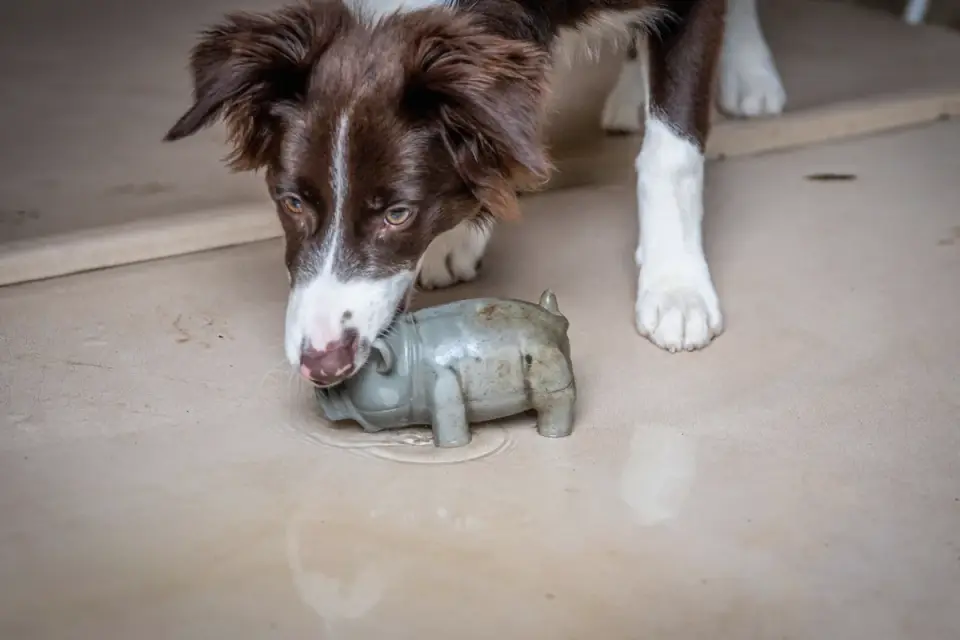
Mounting shows up early, often before a puppy is even six months old, and it has almost nothing to do with hierarchy. Puppies mount littermates, toys, and human legs because the behavior feels good, discharges excess energy, and gets attention — any attention, including a startled laugh. I tell new owners the same thing every time: do not build a narrative around this. A ten-week-old puppy mounting a stuffed toy after a play session is not plotting a coup. It’s a nervous system that hasn’t learned to downshift yet.
Adolescence: hormones and social testing turn up the volume
Between roughly six and eighteen months, mounting often gets more frequent, and this is the stage where owners start asking me about dominance because the timing lines up with adolescence — bigger body, more confidence, more testing of boundaries generally. But the behavior itself hasn’t changed character. It’s still arousal, just riding on a less mature impulse-control system and, in intact dogs, a hormonal backdrop that makes everything a little louder. This is also the age where I see the most crossover with other overstimulation behaviors — a dog that mounts at the dog park is often the same dog that mouths too hard during greetings or struggles to settle after visitors leave.
I had a client bring in a fourteen-month-old intact male Vizsla, about 52 pounds, who’d started mounting every dog he met at the park within the first thirty seconds of the leash coming off. The owner was mortified and assumed he was trying to establish rank over dogs he’d never met before. What we actually found, watching the pattern over a few weeks, was a dog who went from zero to full-body excitement the instant the leash unclipped — no decompression walk, no sniff time, straight into off-leash chaos. Once the owner added a five-minute leashed sniff loop before release and started rewarding a sit at the gate, the mounting dropped off within about three weeks. Nothing about his social rank changed. His arousal ceiling did.
Adulthood: the questions I actually ask before touching training
By adulthood, most dogs have settled into a baseline, and new or escalating mounting deserves a closer look rather than a quick behavioral label. I ask about context first — is it every dog, or specific ones; every greeting, or only after a long car ride or a visit to a busy dog park. I ask whether it’s paired with stiff body language, hard staring, or growling, because that combination is closer to a resource-guarding or overstimulation problem, which reads very differently from a wagging, loose-bodied dog who hops off a mounting attempt the moment you say “off.” A dog that growls when handled or petted in other contexts is telling you something about their threshold for contact generally, and that’s worth reading — our guide on why dogs growl when petted covers the same overstimulation-versus-discomfort distinction from a different angle.
It’s a short list, but it does most of the diagnostic work.
Senior years: when the same behavior means something new
A dog that mounts for the first time at nine or eleven years old is not suddenly discovering dominance late in life. In my experience, new-onset mounting in an older dog is one of those behaviors, like new-onset pacing, that belongs on the “call the vet before you train it” list. Urinary tract discomfort, skin irritation, priapism, and early cognitive changes can all show up as mounting or humping that reads as odd and out of character. If an older dog has also started pacing at night or seems less settled after dark, that’s worth tracking alongside the mounting — we go through that pattern in our piece on why senior dogs pace at night, and the two behaviors sometimes share a root cause.
I remember an eleven-year-old spayed female Cocker Spaniel, about 24 pounds, whose owner called because she’d started mounting a floor cushion twice a day, something she’d never done in her life. The owner’s first assumption was that a new foster dog in the house had “confused” her hierarchy. On exam, she had a mild urinary tract infection and some vulvar irritation. We treated the infection, the irritation resolved over about ten days, and the mounting stopped entirely. It was never about the foster dog. It was a body telling us something the only way it could.
Where calming support genuinely fits, and where it doesn’t
Supplements are not a substitute for the diagnostic work above, and I say that plainly because owners often reach for a calming chew before they’ve ruled anything out. But for dogs whose mounting is clearly tied to situational over-arousal — greetings, visitors, the dog park gate — reducing the baseline arousal level can make the training easier to land. Chamomile has a long history in traditional herbal care for supporting relaxation, though a recent review in Biomedicines notes that for most species, the evidence base is still mainly preclinical or drawn from traditional use rather than large controlled trials. Ashwagandha has firmer human data behind it: a systematic review published in Cureus found a moderate positive effect on stress reduction across multiple randomized trials. L-theanine’s evidence is narrower and more mixed — a review in Molecular Psychiatry found a meaningful effect in one study on psychotic anxiety at 400 mg per day over eight weeks, but that’s a specific population and dose, not a blanket claim for everyday canine excitement.
None of that replaces a leash routine, a decompression walk, or a urinalysis. It’s a supporting lever, not the lever. If your dog’s mounting has any behavioral overlap with anxiety-driven habits — pacing, destructive chewing when left alone, shadowing you room to room — it’s worth reading through how boredom differs from separation anxiety before assuming arousal is the whole story.
My verdict
Dominance theory made intuitive sense decades ago, and it’s still the first explanation most owners reach for, but it doesn’t hold up against what mounting actually looks like across a dog’s life. Puppies mount because their nervous system runs hot. Adolescents mount because hormones and low impulse control amplify normal arousal. Adults mount for identifiable, addressable reasons that almost always trace back to context, not rank. Seniors who start mounting out of nowhere are giving you a medical signal, not a social one. My rule of thumb: manage arousal, rule out medical causes when the pattern is new or sudden, and only then think about calming support as one piece of a bigger routine — never the whole plan.
Frequently asked questions
Is mounting always a sign of dominance in dogs?
No. Most mounting is driven by excitement, arousal, or habit rather than a bid for social rank, especially in puppies and adolescents.
When should I take my dog to the vet for humping?
If mounting starts suddenly in an adult or senior dog, happens without an obvious trigger, or comes with signs like straining to urinate or skin irritation, it's worth a veterinary visit before assuming it's behavioral.
Sources
- Chamomile and Anxiety: Evidence Across Species — Biomedicines
- Ashwagandha and Stress Reduction: A Systematic Review of Randomized Trials — Cureus
- L-Theanine and Anxiety Outcomes: A Review of Controlled Studies — Molecular Psychiatry