On this page
The call, before the caveats
If I had to send one client home with one answer, it’s this: a crash-tested harness or crate beats a bare seat belt clip or a cargo barrier used alone, and it isn’t close. That’s not brand loyalty talking — it’s what happens when you put dog-sized dummies on a sled and run federal-style crash protocols on them. The 2013 Harness Study Results: Center for Pet Safety has done exactly that, repeatedly, since 2013, and the results are the closest thing this category has to hard data.
A barrier keeps a dog out of the front seat. That’s a real job, and it matters. But a barrier does nothing to stop a dog’s body from slamming into the back of that barrier, or into the seat in front of it, during a hard stop. It manages location, not deceleration force. Owners often treat a barrier as “the safety solution” because it looks sturdy and installs in minutes. It isn’t a restraint in the crash-test sense — it’s a containment tool, and conflating the two is where I see people get a false sense of security.
In my practice, the dog I still think about is a 62-pound Golden Retriever named Baxter, four years old, whose owner had a barrier installed behind the second row and assumed that was enough. She braked hard for a deer on a two-lane road outside Ann Arbor one October evening. Baxter wasn’t wearing a harness — he was loose behind the barrier — and he hit it hard enough to bruise his shoulder and chip a canine tooth on the cargo rail. Nothing life-threatening, but an ER visit and a week of reduced activity that didn’t need to happen. His owner switched to a crash-tested harness clipped to the seatbelt anchor within days. That’s the pattern I see over and over: the barrier is the product people buy first, and the harness is the one they buy after something goes wrong.
What “crash-tested” actually means
This is the term that gets abused on packaging, so it’s worth being precise. The Center for Pet Safety tests products using a protocol adapted from Federal Motor Vehicle Safety Standard 213 — the same standard used for child car seats — with dog-sized crash test dummies (roughly 25, 45, and 75 pounds) on a sled simulating a 30 mph impact. In the 2013 study of eleven harnesses, only one, the Sleepypod Clickit Utility, passed without a catastrophic failure across all three dog sizes. Many “car safety” harnesses sold today have never been through this testing at all; the word “safety” on a label is not a certification, it’s marketing copy.
The same organization has run parallel crash tests on crates and carriers, working with Subaru and the MGA Research Corporation sled facility, and found comparable variability: some crates held together and kept the dog contained, others deformed or broke open under load. There is still no government-mandated crash standard for dog crates the way there is for child car seats, so “crash-tested” only means something when you can point to whose test and what protocol.
Seat belt clips vs a real harness
A thin nylon strap that clips your dog’s existing collar to the seatbelt buckle is not the same product as a crash-tested harness. Collar clips put deceleration force on the neck, which is exactly where you don’t want it in a sudden stop — the risk of tracheal or cervical injury is real, and it’s the reason the harnesses that passed CPS testing distribute force across the chest and shoulders instead. If you already own a comfortable walking harness, a seatbelt clip attached to it is better than nothing, but it was not built or tested for crash loads, and I don’t tell clients to rely on it as their primary restraint.
Crates: contained, but only if the crate holds
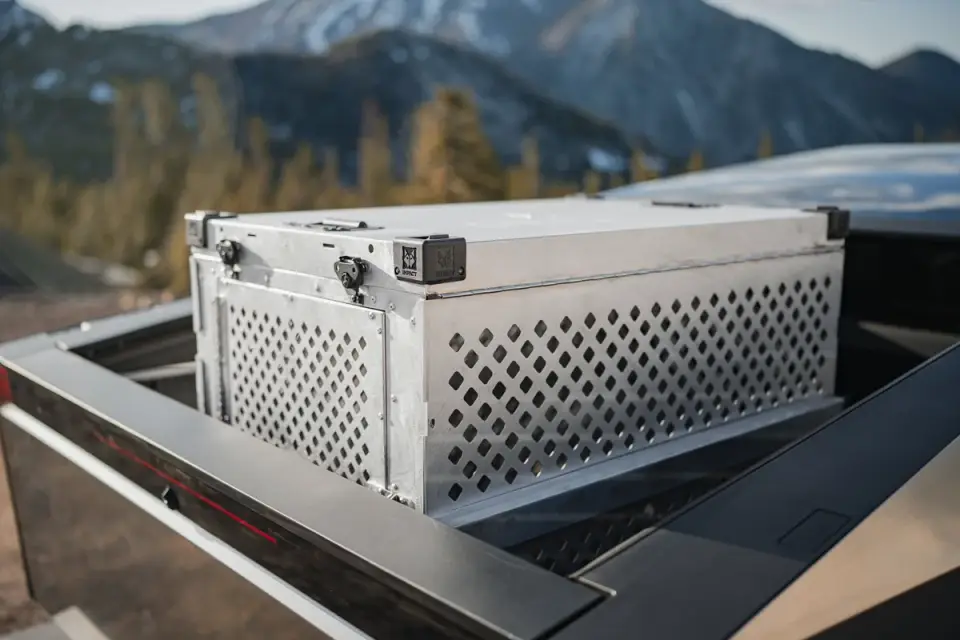
A hard-sided, well-anchored crate is the other legitimate option, and for dogs who travel poorly loose or who ride in the cargo area, it’s often the more practical one. The advantage of a crate is total containment — the dog can’t become a projectile inside the cabin. The catch is that the crate itself has to survive the crash, and that means tie-down points rated for the load, a snug fit (not a crate the dog can slide or roll inside), and, again, evidence that it’s actually been tested rather than assumed sturdy. The Pet Carrier & Crate Crash Test Research: Center for Pet Safety has published crate and carrier results alongside the harness data, and the spread in performance mirrors what they found with harnesses: brand names and price don’t reliably predict outcome.
Where a barrier still earns its place
None of this means barriers are pointless. A barrier stops a dog from climbing into the driver’s lap or the front footwell mid-drive, which is a genuine, everyday distraction risk, and the American Veterinary Medical Association is clear that pets should never ride loose in a vehicle, especially in a seat with an active airbag. My actual recommendation for most owners is to combine the two: a crash-tested harness or crate to manage crash force, plus a barrier to keep the dog out of the front seat if the restraint is ever unclipped for a rest stop or a quick errand. Treat the barrier as a second layer, not the whole plan.
A practical sequence I give clients
Start with the dog’s size and how the vehicle is set up, then work down this list in order:
- Confirm the seat. Back seat only, away from any active airbag, per AVMA guidance.
- Check for real crash-test data, not just the word “safety” on the box — the Center for Pet Safety results page is the most complete public record.
- Pick harness or crate based on how the dog actually rides — a dog who settles well in a harness doesn’t need to be crated, and a dog who paces or tries to climb between seats usually does better contained.
- Add a barrier if the vehicle allows it, as a backup layer, not a substitute.
- Size and fit before anything else — a loose harness or an oversized crate undoes most of the benefit regardless of test results.
For dogs who ride poorly during the transition, it helps to pair this with the broader groundwork covered in How to Travel With a Puppy for the First Time, and owners flying rather than driving should see How to Fly With a Dog: The Complete Guide for how crate requirements differ in that setting.
One line worth remembering on its own: no restraint eliminates risk, it only reduces it.
The verdict, restated
I’ve watched enough ER visits from “he was fine loose in the back” to be blunt about this. A crash-tested harness, correctly fitted and clipped to the seatbelt anchor, is my default recommendation for most dogs who ride in the passenger cabin. A crash-tested crate is the better call for dogs who don’t settle in a harness or who already ride in a cargo area. A barrier is a useful add-on for keeping a dog out of the front seat, but it is not a substitute for either, and treating it as one is the single most common mistake I see. If you do nothing else after reading this, check whether your current harness or crate has actual crash-test data behind it — not just the word “safety” printed on the packaging.
Frequently asked questions
Is a seat belt clip on a regular collar safe for car travel?
Not as a primary restraint. A collar clip concentrates crash force on the neck; a crash-tested harness that distributes force across the chest is the safer choice, per Center for Pet Safety testing.
Do dog crates need to be crash-tested to be safe in a car?
There's no government mandate for it, but crash-test data is the only real evidence a crate will hold together under impact rather than just looking sturdy.
Can a cargo barrier replace a harness or crate?
No. A barrier keeps a dog out of the front seat but does nothing to slow the dog's body during a sudden stop, so it works best as an added layer, not a stand-alone restraint.
Sources
- 2013 Harness Study Results — Center for Pet Safety
- Pet Carrier & Crate Crash Test Research — Center for Pet Safety
- Pet safety in vehicles — American Veterinary Medical Association