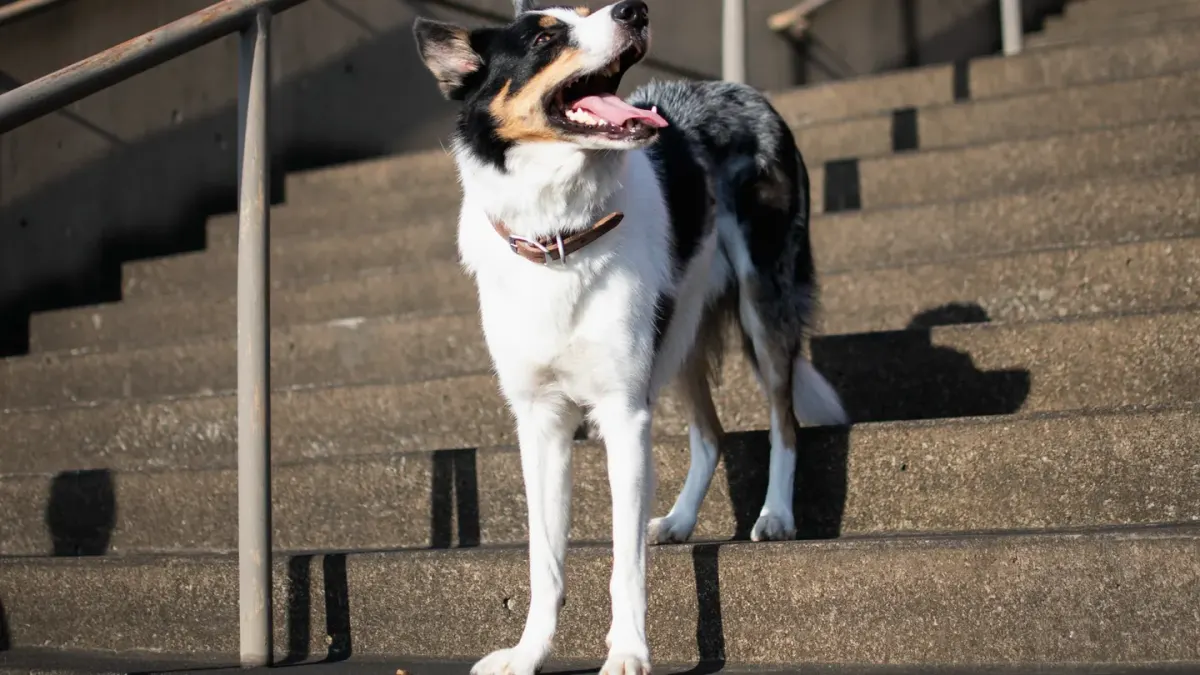
Why does a dog who’s climbed the same stairs for years suddenly pause at the bottom at 11 p.m., ears back, one paw testing the first step before committing? An owner I worked with described exactly that with her ten-year-old Lab mix — fine all day, then hesitant every night after she’d been lying still for a few hours. That pattern, stiffness after rest that eases once a dog gets moving, is one of the most common early signs of joint wear, and it’s usually what sends owners searching for glucosamine.

What is glucosamine actually doing inside the joint? It’s a building block the body already uses to make and maintain cartilage — the cushioning tissue at the ends of bones. Supplementing it gives the joint more raw material to work with. A review in the Journal of Veterinary Medical Science found that glucosamine hydrochloride can help prevent experimentally induced cartilage degradation in vitro. In plain terms: in lab conditions, it slowed the kind of breakdown that makes joints hurt and stiffen. That’s not the same as proof it reverses arthritis in a living dog, but it’s the mechanism the rest of the evidence builds on.
How strong is the evidence, honestly? Reasonably strong on mechanism, thinner on head-to-head clinical outcomes in dogs specifically. This is where I think in terms of balance rather than a single lever. In TCM framing, joint stiffness that worsens at night and after rest often reads as a stagnation pattern — movement is what disperses it, which is consistent with what owners actually describe: dogs loosen up once they’re a few steps into the walk. Glucosamine supports that from the tissue side; keeping a dog moving gently supports it from the activity side. Neither replaces the other.
What about chondroitin and green-lipped mussel alongside it? Glucosamine and chondroitin are among the most studied joint support ingredients for dogs, and they’re rarely used alone for a reason — they act on different parts of the same problem. Chondroitin’s role leans toward joint fluid quality: research published in Frontiers in Veterinary Science describes chondroitin as supporting healthy synovial fluid homeostasis, which is the lubrication side of the equation rather than the cartilage-building side glucosamine covers. Green-lipped mussel adds a third angle. Research in Nutrients found that mussel-derived compounds reduced paw swelling and lowered inflammatory markers, including TNF-α and IL-17, in animal models — evidence for an anti-inflammatory contribution, distinct from what glucosamine or chondroitin do on their own.
So does a three-ingredient formula work better than glucosamine by itself? Probably, for a dog whose stiffness has an inflammatory component as well as a structural one. But more ingredients isn’t automatically better if the doses are too low to matter, so read a label for actual milligrams per serving, not just an ingredient list.

How do you know if it’s actually helping? Track something concrete instead of a general impression. Note how many seconds it takes your dog to commit to the first stair, whether she takes stairs one at a time or two-footed, and whether the hesitation shows up only at night or also after naps during the day. Recheck that same measure at two and four weeks. Glucosamine builds cartilage gradually; it isn’t going to change a stiff dog into a bounding one by day three, and expecting that is the most common reason owners quit a trial too early.
When should you stop waiting and call the vet instead? If the stair avoidance came on suddenly rather than gradually, if it’s worse on one side than the other, or if it’s paired with yelping, limping, or reluctance to bear weight at all, that’s not a supplement question anymore. Those patterns can point to a torn ligament, a disc problem, or something else that needs a diagnosis, and a joint supplement started on the wrong problem just buys time you didn’t need to spend. For a dog with plain, gradual, rest-then-stiff joint wear, though, glucosamine paired with chondroitin is a defensible, evidence-grounded place to start — just give it the weeks it needs before you decide whether it’s working.
Frequently asked questions
How long before glucosamine helps a dog struggling with stairs at night?
Most owners who see a difference report it over several weeks, not days. Glucosamine works by supporting the cartilage matrix over time rather than blocking pain in the moment, so give it a full month before judging whether it's doing anything.
Is glucosamine alone enough, or does it need chondroitin too?
Glucosamine and chondroitin are among the most studied joint-support ingredients for dogs and are commonly paired because they act on complementary parts of joint biology — cartilage building blocks and synovial fluid quality, respectively.
Could the stair struggle be something other than joints?
Yes. Vision changes, ear or vestibular issues, and neurologic conditions can all look like joint pain at night. If the hesitation is sudden, one-sided, or paired with yelping, stumbling, or confusion, that's a vet visit, not a supplement trial.
Sources
- Chondroitin sulfate supports synovial fluid homeostasis — Frontiers in Veterinary Science
- Glucosamine hydrochloride and cartilage degradation, an in vitro review — Journal of Veterinary Medical Science
- Green-lipped mussel extract and inflammatory joint markers — Nutrients