On this page
Before you carve a piece off for the dog under the table, run this list:
- Meat only — no skin, no visible fat cap, no drippings or gravy poured over it
- Fully cooked, cooled to room temperature, cut into bite-sized pieces
- Completely boneless — cooked poultry bones splinter and do not get a pass just because they’re small
- Unseasoned — no onion, garlic, or heavy sage-and-butter stuffing mix touched the meat
- A small portion relative to the dog’s regular meal, not a second dinner
- Extra caution for dogs with a history of pancreatitis, a sensitive stomach, or any breed known to run that risk
Every item on that list exists because of a specific failure mode vets see, not because turkey itself is a risky protein. Lean, plain turkey breast is nutritionally unremarkable in a good way — it’s a mild, low-residue protein that most healthy dogs tolerate as well as chicken. The problem is that almost no turkey a dog encounters in real life is plain.
Why “Turkey Is Lean and Safe” Only Tells Half the Story
The myth is that turkey is a uniformly safe, even healthy, treat because it’s the same bird that shows up in prescription and limited-ingredient dog foods. The reality is that the turkey a dog is actually offered — off a holiday table, out of a sandwich, scraped off a plate — rarely resembles the trimmed, skinless breast in a commercial formula. Skin and drippings carry a fat load that a dog’s system did not evolve to handle in one sitting, and that fat load is the documented driver of holiday-season pancreatitis cases, not the muscle meat underneath it. I don’t treat turkey meat and turkey skin as the same food, and I’d encourage owners to stop mentally lumping them together.
Garlic, onion, and onion powder deserve their own line item, separate from the fat conversation. Every part of the allium family is toxic to dogs in any form — raw, cooked, dried, or powdered — and there is no established safe dose, according to VCA Animal Hospitals. The Merck Veterinary Manual describes the same allium compounds as capable of damaging red blood cells regardless of how the onion or garlic was prepared. A stuffing-adjacent slice of turkey that absorbed pan drippings seasoned with onion and garlic is not a safe substitution just because the meat itself is fine.
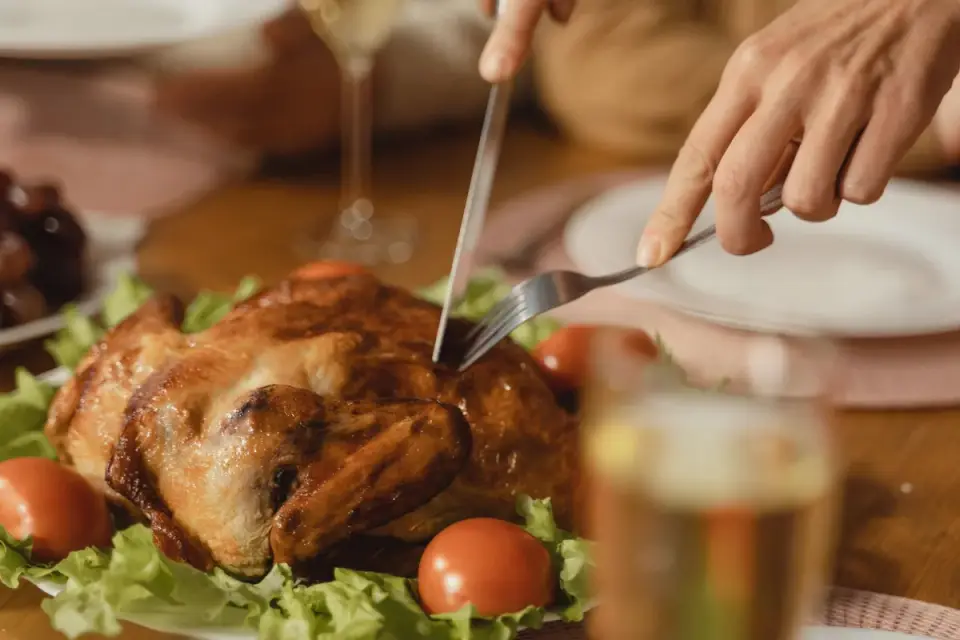
Picture a household hosting a mid-size gathering, a bird resting on the counter, and a food-motivated dog working the kitchen perimeter all afternoon. Nobody hands over a full plate; instead it’s a scrap of skin here, a spoon-scraped gravy boat there, a piece of stuffing that fell near the dog bowl. Individually, none of it looks like an emergency. Cumulatively, it’s exactly the fat-and-seasoning combination that sends dogs to emergency clinics the day after a holiday meal, well past the point where a single obviously bad decision would have been easy to catch. The lesson isn’t that turkey day is dangerous — it’s that the risk accumulates in small, easy-to-miss increments, which is why I’d rather owners set the plain-meat boundary before the meal starts than try to police it dish by dish once it’s underway.
What’s Actually Happening Inside the Gut After a Fatty Plate
When a dog’s system is overloaded with fat and rich table food, the downstream effects show up in digestion, not just in the pancreas. Chronic or repeated pancreatic insult can progress toward exocrine pancreatic insufficiency, which is managed with pancreatic enzyme replacement therapy, a lower-fat and low-residue diet, and cobalamin supplementation, according to a review in JAVMA. That same review notes that dysbiosis — an imbalanced gut microbial community — often persists even after enzyme therapy starts, and researchers still don’t fully understand why. That’s a useful, humbling data point for anyone tempted to treat a probiotic or digestive supplement as a guaranteed fix once a dog’s gut has already been disrupted by a fatty meal.
Probiotics can still be a reasonable part of supporting recovery, but the evidence is more nuanced than marketing usually allows. A peer-reviewed trial in Frontiers in Veterinary Science found that diversity metrics of the gut microbiome did not distinguish dogs who responded to a probiotic from those who didn’t — meaning a more diverse microbiome at baseline wasn’t a reliable predictor of who would benefit. I read that as a reason to keep expectations bounded: probiotics may help support digestive recovery in some dogs, but they aren’t a universal reset button, and they don’t undo the effect of a genuinely fatty meal.
A Practical Sequence for Serving Turkey Without an ER Visit
Start with the protein alone, cooked and cooled, cut small, and offered as a topper rather than a meal replacement — the same portioning logic that applies to sweet potato or any other occasional add-in. Skip the skin and pan juices entirely rather than trying to estimate a “safe” amount of fat, since there isn’t a reliably safe threshold for a dog prone to pancreatitis. If the household is also serving a fiber-heavy side like stuffing or mashed vegetables, be deliberate about how much makes it into the dog’s bowl; it’s easy to stack more fiber onto a dog’s plate than intended, and too much fiber creates its own GI discomfort separate from the turkey question. For dogs already on a joint or senior-support routine, plain turkey is a fine way to make a pill or chew more palatable, similar to the logic behind crushing a longevity chew into food rather than a reason to change the supplement itself.
Consider a household managing an older dog with a known sensitive stomach, trying to include the dog in a family meal without triggering a bad night. The safer move isn’t avoiding turkey altogether — it’s separating out a small piece of breast meat before any seasoning, skin, or gravy touches the rest of the serving, and treating that plain piece as the dog’s actual portion rather than an approximation of what’s already on the table. That small act of intentional separation is doing almost all of the protective work, more than any specific quantity limit could.
Where I’d Draw the Line
Healthy adult dogs tolerate small amounts of plain turkey breast without issue, and I don’t think owners need to treat it as a special-occasion risk when it’s prepared correctly. Where I get stricter is with puppies still building digestive tolerance, seniors with any pancreatitis history, and any dog on a strict low-fat therapeutic diet — for those dogs, the margin for a seasoning mistake or a fatty scrap is thinner, and I’d rather set the boundary before the meal than manage the aftermath. If your dog does get into bones, skin, or an allium-seasoned dish, don’t wait out the evening to see what happens; call your veterinarian and describe exactly what and how much was eaten.
Frequently asked questions
Can dogs eat turkey skin?
I'd skip it. The fat concentrated in turkey skin is a well-documented trigger for digestive upset and pancreatitis in dogs, especially around holiday meals.
Is turkey a good everyday protein for a dog with a sensitive stomach?
Plain turkey breast is lean and low-residue, which is useful, but any new protein should be introduced gradually and watched for loose stool.
What if my dog swallowed a piece of turkey bone?
Call your vet or an emergency clinic rather than waiting it out. Cooked poultry bones splinter and can cause obstruction or perforation, and that risk doesn't resolve on its own.
Does turkey cause food comas or lethargy in dogs the way it's rumored to in people?
Not meaningfully. The sedative reputation of turkey's tryptophan is overstated even in humans, and the doses in a dog's portion are not the reason for post-holiday sluggishness — overeating and fat are.
Sources
- Exocrine Pancreatic Insufficiency: Diagnosis, Management, and Persistent Dysbiosis Review — JAVMA
- Probiotic Response and Gut Microbiome Diversity Metrics in Dogs — Frontiers in Veterinary Science
- Onion, Garlic, Chive, and Leek Toxicity in Dogs — VCA Animal Hospitals
- Garlic and Onion (Allium spp) Toxicosis in Animals — Merck Veterinary Manual