On this page
- Weeks 8 to 10: why the mouth is the main tool, not the problem
- Weeks 10 to 16: this is where bite inhibition actually gets built
- Months 4 to 6: teething turns the volume up
- When biting looks like something else entirely
- Where calming ingredients might factor in, and where they won’t touch the real problem
- The bottom line, and what to do this week
The verdict, up front: you don’t stop puppy biting by stopping it. You stop it by shaping it. Punishing every nip usually backfires — it either escalates the bite or teaches a puppy to bite without warning. The dogs I’ve seen make the fastest, cleanest progress are the ones whose owners stopped chasing “zero contact” and started teaching bite inhibition, redirecting to the right thing to chew, and managing the specific windows (overtired, overstimulated, teething) when the mouth gets busiest.
I still remember a Bernedoodle named Otis, ten weeks old and about 14 pounds, who’d draw blood on his owner’s forearms every evening around 6 p.m. — right after the kids got home from school and the whole house got loud. The owners had tried yelping, tried a firm “no,” tried holding his muzzle shut, and nothing stuck because none of it addressed the actual trigger: Otis was overstimulated at the exact hour the house was busiest, and biting was how an overtired ten-week-old puppy blew off pressure. Once they moved his evening feeding and a chew session earlier, before the 6 p.m. chaos, the bruising stopped within about two weeks. The behavior wasn’t defiance. It was a schedule problem wearing puppy teeth.
Weeks 8 to 10: why the mouth is the main tool, not the problem
At this age, a puppy explores almost everything mouth-first, the same way a toddler explores with their hands. Littermates taught bite pressure through play, yelping and disengaging when a bite hurt too much — and a new home has to pick up that lesson without a canine teacher in the room. This is the stage where I tell owners to expect mouthing, not to be alarmed by it, and to start teaching bite inhibition immediately rather than waiting for it to become a “real” problem.
The mechanics are simple and worth doing consistently from day one: when teeth touch skin too hard, make a short, sharp sound, stop all movement and attention for ten to fifteen seconds, then resume play. The goal in these first weeks isn’t “no mouth on skin” — it’s “softer mouth on skin.” Trying to skip straight to zero contact at eight weeks usually just teaches a puppy that hands are unpredictable, which can make mouthing more frantic, not less.
Weeks 10 to 16: this is where bite inhibition actually gets built
By ten to twelve weeks, most puppies can start learning graded pressure — a nip that barely registers gets ignored, a hard bite gets an immediate pause in play. Consistency matters more than intensity here. Every person in the house needs to use the same response, or the puppy just learns that biting works with some people and not others.
This is also the window to build “trade, don’t grab” as a habit: if a puppy’s mouth lands on a sleeve or a hand, offer an appropriate chew instead of yanking away, which tends to trigger a chase-and-bite reflex. Frozen textures work well for a lot of puppies in this stage — a frozen rubber puzzle toy, or for owners who want a food-based option, a frozen chunk of cooked, mashed sweet potato in a stuffable toy can give a teething puppy something satisfying to gnaw that isn’t a wrist.
Months 4 to 6: teething turns the volume up
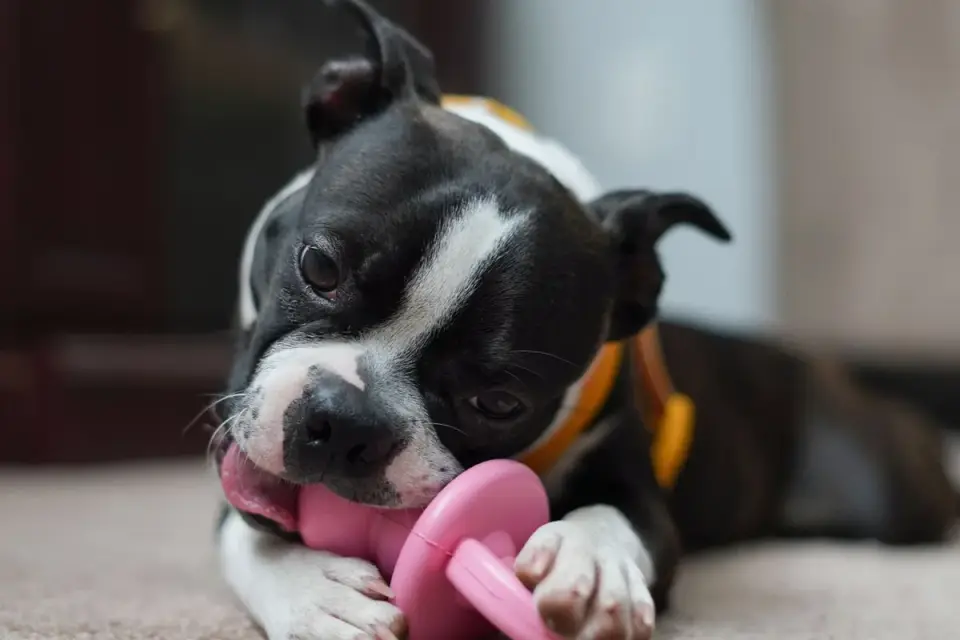
Somewhere between four and six months, adult teeth start pushing through, and a lot of puppies who’d mostly settled down start mouthing again, harder and more often. Owners frequently describe this as the dog “backsliding,” but it’s usually just sore gums looking for relief. This is the stage where rotating chew textures — rubber, rope, and cold — matters more than any single training cue, because the underlying driver is physical discomfort, not a behavior lapse.
I worked with a Labrador mix named Sadie, five months old and right in the middle of this window, whose owner called worried that months of progress had “disappeared overnight.” Sadie had gone from a puppy who mostly played gently to one drawing yelps again, always in the twenty minutes after dinner. Nothing else had changed — same routine, same training. What had changed was that her adult canines were erupting. Switching her evening chew rotation to something colder and firmer, and shortening the post-dinner play window, brought her back to baseline within about ten days. It wasn’t a training failure; it was a jaw doing what jaws do at that age.
When biting looks like something else entirely
Not every hard mouth is teething or normal puppy roughness. A sudden increase in biting intensity, biting paired with stiffening or a hard stare, or biting that shows up specifically around a resource — a bone, a bed, a food bowl — deserves a closer look, because it may be closer to resource guarding or fear than exploratory mouthing. Reading the difference between “excited puppy” body language and a genuine warning sign matters, and the same body-language literacy that helps with mouthing also helps owners catch it when a dog is growling during petting rather than play.
Gut health is worth a mention here too, since a puppy who’s uncomfortable is often a puppy with a shorter fuse. If a puppy’s stool has been loose or inconsistent while you’re also troubleshooting a diet change, it’s worth checking whether you’ve overshot on fiber before assuming the biting itself needs a bigger intervention.
Where calming ingredients might factor in, and where they won’t touch the real problem
Owners often ask about calming chews for an overstimulated or teething puppy, and the honest, evidence-scored answer is: they’re a minor supporting piece at best, never the fix. Chamomile has traditional use for supporting relaxation, and a review in Biomedicines notes that “for the remaining species, evidence is derived mainly from preclinical studies or traditional use” — that’s a thin evidence tier, not a green light to expect it to solve a biting problem. Ashwagandha has somewhat firmer human data: a systematic review in Cureus “analyzed multiple RCTs and concluded that ashwagandha has a moderate positive impact on stress reduction and cognitive performance,” though that’s human research, not canine. L-theanine’s human evidence is narrower still — a review in Molecular Psychiatry found a meaningful effect in “one study on psychotic anxiety (SMD = 0.54; 400 mg/day for 8 weeks),” which is a specific population and dose, not a general puppy-calming guarantee.
My honest read: none of that evidence is strong enough to lean on for a biting puppy. Management — sleep, chew rotation, timing play around known trigger windows — does the real work. If a genuinely anxious temperament is layered on top of normal teething, a calming ingredient might be one small piece of a broader plan your vet helps design, not a substitute for the schedule and training changes above.
The bottom line, and what to do this week
My verdict hasn’t changed in years of seeing this in the exam room: teach bite inhibition before you try to eliminate mouthing outright, redirect to the right chew before the wrong bite happens, and treat teething months as a physical problem first. If a puppy over six months is still biting hard, biting without any warning signs, or biting in a way that draws blood regularly, that’s past the range of normal development and it’s time to bring in a certified trainer or your veterinarian rather than keep troubleshooting solo.
This week, start with the boring, mechanical part: log the times of day biting spikes, and see whether it clusters around a nap that got skipped, a feeding time, or a busy hour in the house. That pattern is usually more useful than any single training trick.
Frequently asked questions
At what age do puppies usually stop biting so hard?
Most puppies show a real drop in bite force somewhere between three and five months as bite inhibition sets in, though teething between four and six months can bring a temporary spike back.
Should I yelp when my puppy bites too hard?
A short, sharp sound followed by briefly stopping play can work well for many puppies, but if a puppy gets more excited or bites harder in response, switch to a calm, silent pause instead.
Is it normal for puppy biting to suddenly get worse?
A sudden increase is common during teething (roughly four to six months) or after a schedule change, but if it comes with stiff body language or shows up around a specific resource, have it evaluated rather than assuming it's a phase.