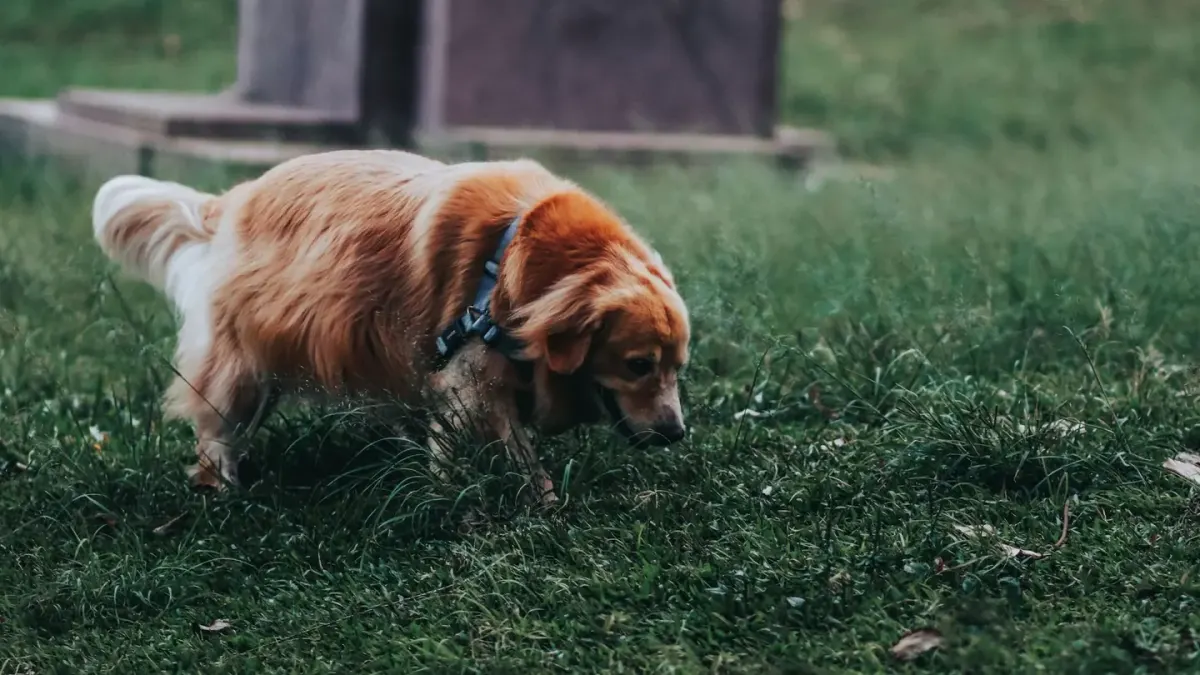
On this page
The call: stop guessing at a single cause. Coprophagia — the clinical term for stool eating — has at least three distinct drivers, and the fix that works for a nutrient-deficient puppy will do nothing for a bored adolescent or an anxious senior. Sort out which category your dog is actually in before spending money on a remedy.
I’ve had this conversation more times than almost any other behavior question in my exam room, and it usually starts the same way: an owner apologizing, half-laughing, half-mortified. There’s no need for either. This is common, it’s rarely dangerous by itself, and it responds to a fairly short list of interventions once you know which lever to pull.
The Myth That Keeps This Habit Alive
The most persistent belief I hear is that a dog eats stool because it’s “missing something” in its diet — an enzyme, a mineral, some invisible nutritional gap that a supplement will patch. It’s a tidy story, and it’s why enzyme powders sell so well. The reality is messier: coprophagia shows up across well-fed dogs, poorly-fed dogs, puppies, and seniors, and the behavior overlaps heavily with stress, boredom, and simple opportunity. Treating it as purely a diet problem is the single most common reason owners tell me “we tried everything and nothing worked.”
What Coprophagia Actually Tracks With
Puppies and Maternal Instinct
Mother dogs clean up after their litters as a matter of course, and puppies raised around that behavior sometimes carry a version of it forward. Most puppies age out of this on their own by twelve months as their environment and diet stabilize; it’s the category with the best spontaneous resolution rate.
Medical and Malabsorption Causes
Pancreatic insufficiency, intestinal parasites, and malabsorptive disease can genuinely change stool smell and nutrient content in ways that make it more attractive to a dog. This is the category worth ruling out first, and it’s the one owners skip most often because it means a vet visit instead of a bag of chews.
Diet and Digestive Efficiency
A dog whose food isn’t being digested well downstream produces stool that still smells like food. Fiber levels, protein quality, and portion size all play into this — our guide on fiber ceilings owners miss covers how too much of a good thing can backfire, and our piece on sweet potato prep and portions walks through how digestible carbohydrate choices affect stool consistency. Gut flora support is part of this conversation too; our look at probiotic chew cost per serving is relevant if a dog’s stool has been loose or inconsistent.
Behavioral, Attention, and Stress-Linked Eating
This is the category owners underestimate. Some dogs eat stool because it reliably produces a reaction — even a scolding is attention. Others do it in kennel or crate settings out of confinement stress, or as part of a broader anxious repertoire. It’s worth reading that overlap the same way you’d read why dogs growl when petted: a symptom that needs context, not a single universal fix.
I once worked with a nine-year-old spayed Border Collie mix named Fen, about 38 pounds, whose owner noticed the habit had started only after they moved into an apartment with a smaller yard and a much shorter window for the morning walk. Fen had never done this at the old house. Her stool consistency was normal, her bloodwork was unremarkable, and the pattern only appeared on weekday mornings, never weekends. That timing detail was the whole diagnosis — this wasn’t a nutrient gap, it was a rushed routine that had turned yard time into something stressful. We didn’t touch her diet. We extended the morning walk by ten minutes and added an evening decompression sniff walk, and the behavior dropped off within about three weeks. Not every case resolves that cleanly, but the lesson generalizes: the timeline of onset tells you more than the stool itself does.
The Sequence That Actually Works
Skipping steps is why “we tried everything” so often means “we tried three things at once and couldn’t tell what helped.”
- Rule out medical causes first. A fecal exam and basic bloodwork take the malabsorption and parasite categories off the table before you spend money guessing.
- Clean up management before you touch behavior. Immediate, consistent yard pickup removes the opportunity entirely — a dog can’t eat what isn’t there, and this alone resolves a meaningful share of cases without anything else changing.
- Address the diet variable, if indicated. If stool has been loose, unusually large, or strong-smelling, a digestibility or fiber-load review is worth doing before assuming it’s behavioral.
- Work the behavioral layer last, and specifically. Redirect with a “leave it” cue reinforced away from the yard, increase structured exercise, and reduce time spent unsupervised in a space with stool present.
Where Stress Fits, and Where It Doesn’t
For dogs whose stool eating tracks with confinement, new environments, or general anxious behavior rather than diet or medical findings, addressing the underlying stress can matter as much as any yard-management step. This is where I’m careful with owners: calming ingredients are structure/function support for the anxious state, not a targeted fix for coprophagia itself. A review in Biomedicines notes that for most species, evidence on chamomile for anxiety and stress is still derived mainly from preclinical studies or traditional use — worth knowing before expecting a fast, dramatic change. A systematic review in Cureus found that ashwagandha has a moderate positive impact on stress reduction and cognitive performance across the human RCTs it analyzed, which is the strongest of the evidence tiers here, though it’s not dog-specific data. And a review in Molecular Psychiatry found meaningful support for L-theanine in only one anxiety study, at 400 mg/day over eight weeks — a reminder that “calming supplement” covers a wide range of evidence quality, and none of it substitutes for the management steps above.
I think about a Cavalier King Charles Spaniel I saw, seven years old, about 16 pounds, whose owner had tried an enzyme powder for two months with no change before we ever spoke. Once we mapped out when the behavior actually happened — almost always right after the dog was left alone in the laundry room — it was clearly confinement stress, not a nutrient issue. We changed where she was left alone, added more structured exercise before departures, and the enzyme powder came off the shopping list entirely. It wasn’t the supplement that was wrong for her; it was that nobody had asked what the behavior was actually reacting to.
When to Call Your Veterinarian
Bring in your vet if the behavior started suddenly in an adult dog with no environmental change, if stool consistency or appetite has shifted alongside it, or if management and behavior steps haven’t moved the needle after several weeks of consistent effort. Sudden-onset cases in older dogs deserve a medical workup before anything else.
Looking ahead, the dogs who do best are the ones whose owners stopped looking for a single silver-bullet product and started treating this as a short diagnostic process — medical, then management, then diet, then behavior. That order rarely fails to at least clarify what’s actually going on, even when it doesn’t fully solve it on the first pass.
Frequently asked questions
Is eating poop dangerous for my dog?
It's rarely dangerous on its own, though it can transmit intestinal parasites if the source dog is infected, which is another reason a fecal exam is worth doing early.
Will a coprophagia-specific supplement fix the behavior?
It depends entirely on the underlying driver. If the cause is medical or stress-linked rather than a taste-based habit, a supplement marketed specifically for stool eating is unlikely to be the deciding factor on its own.
How long does it take to see improvement?
Management changes like immediate cleanup can show results within days; behavioral and stress-linked cases more typically take several weeks of consistent routine changes before the pattern shifts.
Sources
- Review: Chamomile for Anxiety and Stress Across Species — Biomedicines
- Systematic Review of Ashwagandha (KSM-66) for Stress and Cognitive Performance — Cureus
- Review of L-Theanine Evidence for Anxiety — Molecular Psychiatry