What Does Whale Eye Mean in Dogs?
Medically reviewed by Jessica Ennis, DVM, CVA — For general education — not a substitute for veterinary care.
Whale eye isn't your dog being odd, it's the sclera showing because leaving isn't an option yet, so change what you're doing, not your dog.
On this page
Stop what you’re doing. That’s the short version of what whale eye means, and it’s worth leading with because most owners do the opposite: they lean in closer, they ask “what’s wrong, buddy?” in a baby voice, they take a photo. If your dog has turned its head away from something while keeping its eyes locked on it, so the white crescent of the sclera shows at the corner, the dog is telling you it isn’t comfortable and can’t leave. Everything else in this piece is about reading that moment correctly and responding to it, not about diagnosing your dog as broken.
What you’re actually looking at
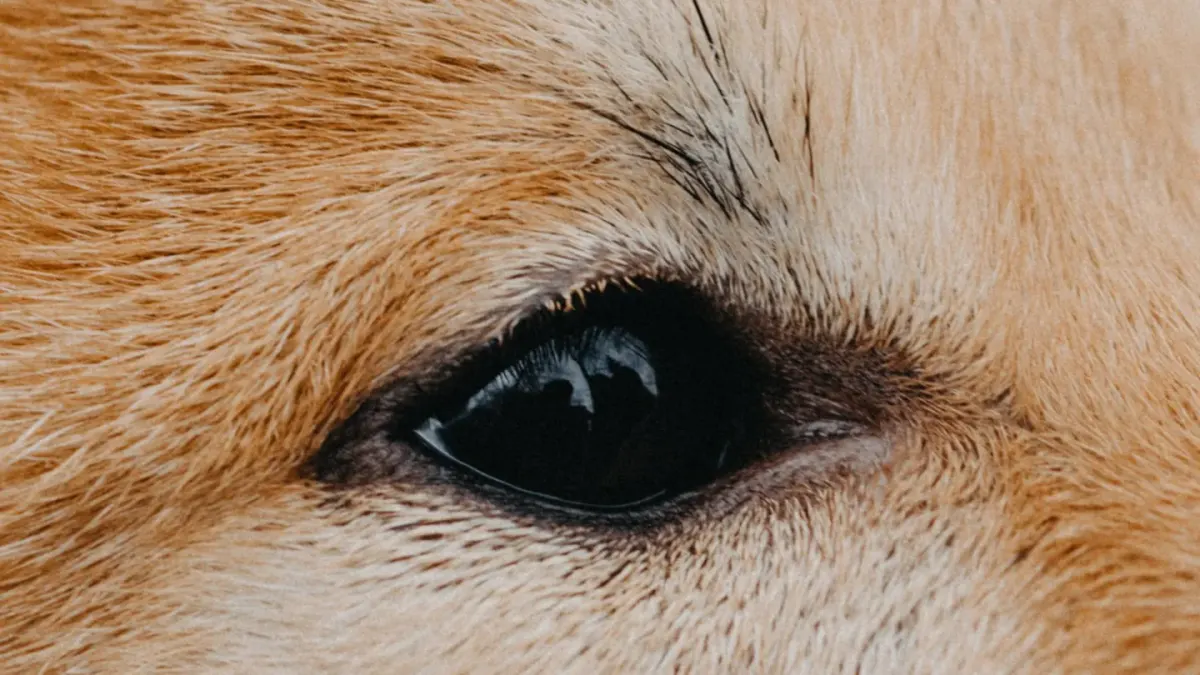
Dog eyes don’t usually show much white. When a dog turns its head partway away from something, whether a hand reaching for a food bowl, a toddler leaning in for a hug, or a stranger looming over a crate, but keeps its eyes fixed on that thing, the eyeball rotates enough to expose the sclera in a half-moon shape. That’s whale eye, sometimes called half-moon eye. It usually shows up alongside a stiff body, a closed or tense mouth, ears pinned or held oddly still, and a tail that’s stopped its loose wag. According to the Resource Guarding in Dogs: How to Deal With This Problematic Behavior: Resource Guarding in Dogs guide from the American Kennel Club, whale eye commonly appears together with body stiffening, a hard stare, lip lifting, and low growling when a dog is guarding food, a bone, or a favorite toy.
The important thing to understand is what the signal is for. It isn’t aggression. It’s an attempt to avoid a conflict without one. The Understanding Dog Body Language: Decipher Dogs’ Signs & Signals: American Kennel Club’s guide to reading dog body language frames whale eye as one entry in a much longer vocabulary dogs use before they ever growl or snap, and that sequencing matters more than any single frame of video.

Why it happens in the first place
Whale eye is a conflict-avoidance signal, and dogs reach for it in situations where they feel cornered, outnumbered, or unable to control their own distance from something. That’s a hand coming down over the head instead of under the chin. That’s a second dog crowding a bully stick. That’s a grooming table, a nail trim, a vet exam room, a car that smells like the last unpleasant vet visit. Norwegian trainer Turid Rugaas built her career cataloguing signals like this one under the umbrella term “calming signals,” and whale eye sits in that same family, along with lip licking, yawning out of context, and turning the whole body away. The point of all of them is the same: the dog is trying to lower tension without escalating.
I’ve watched this play out dozens of times in exam rooms, but one visit stands out. A nine-year-old Cavalier King Charles Spaniel named Biscuit, about 17 pounds, came in for a routine dental cleaning consult. Her owner mentioned, almost as an aside, that Biscuit had started “giving them a look” whenever the grandkids reached over her bed to pet her, something that had only started in the past two months. On the exam table Biscuit showed textbook whale eye the second I reached toward her head from above rather than letting her see my hand approach. Nothing about her exam was abnormal. What had changed was that the grandkids, now old enough to run around the house, had started surprising her from behind while she slept. Once the family started waking her with a voice cue before touching her, the look stopped showing up within about three weeks.
The three situations where it shows up most
Resource guarding is the one most owners recognize, because it’s usually tied to food, bones, beds, or a person the dog considers “theirs.” Being cornered or restrained is the second, and it covers grooming, vet visits, nail trims, being hugged, or being reached for from above the head. Startle and novelty is the third: a stranger looming in, a hand appearing suddenly in peripheral vision, a loud noise followed immediately by contact. In all three, the thread connecting them is the same. The dog cannot easily create distance from whatever is making it uncomfortable, and whale eye is what shows up in that gap between wanting to leave and being stuck.
This overlaps with reactivity that has nothing to do with guarding at all. Dogs who startle more easily than they used to, especially older dogs whose hearing or vision has started to shift, often show whale eye in situations that never used to bother them, a topic covered in more depth in why an old dog startles at sounds he used to ignore. And whale eye during ordinary affection, not just guarding, deserves its own read; it’s the subject of why does my dog growl when I pet him, which walks through pain, past experience, and overstimulation as separate causes worth ruling out one at a time.
What not to do when you see it
Don’t lean closer to look. Don’t reach in to “check” what’s bothering the dog. Don’t punish a growl that follows whale eye, because punishing the growl doesn’t remove the discomfort, it just removes the dog’s willingness to warn you before the next escalation. Don’t hold a dog still through a whale-eye moment because you’re in a hurry to finish nail trims or a bath. Every one of those responses teaches the dog that the signal doesn’t work, which is exactly the wrong lesson if you want a dog that keeps communicating instead of skipping straight to a snap.
What to actually do in the moment
Back off the pressure first, even a foot or two of extra space changes the picture. Redirect the interaction instead of forcing it through, coming at a resource-guarding dog from the side with a trade rather than a takeaway, or letting a head-shy dog see your hand coming from below instead of above. Give the dog an exit if one exists, an open door, room to step back, a chance to move away from a crowded hallway. Then note the pattern: what preceded it, what time of day, what surface or room, because a whale eye that only appears in one specific context is a training problem, and a whale eye that’s spreading to more and more everyday situations is worth a veterinary behavior consult.
Where calming support fits, and where it doesn’t
None of this is a supplement problem on its own, whale eye is a communication signal, not a diagnosis. But for dogs whose baseline stress runs high enough that whale eye shows up frequently across ordinary situations, not just genuine resource conflicts, some owners look at calming ingredients as one piece of a broader plan that still includes management and, often, training. Chamomile has a long history in traditional herbal care aimed at supporting relaxation, though a recent review in Biomedicines notes that for most species, including dogs, the supporting evidence is still mainly preclinical or drawn from traditional use rather than controlled trials. Ashwagandha has a somewhat stronger human evidence base; a systematic review published in Cureus that pooled multiple randomized controlled trials concluded the herb has a moderate positive effect on stress reduction and cognitive performance, though that data comes from human trials, not canine ones. L-theanine, an amino acid found in tea, has also been studied for calming effects, and a review in Molecular Psychiatry found a meaningful effect in one human trial on psychotic anxiety using 400 mg per day over eight weeks, a dose and population that doesn’t map directly onto dogs. I’ll say this plainly to clients: these ingredients may help support a calmer baseline in some dogs, but they’re not a substitute for reading the signal and changing what triggers it, and I don’t reach for them before I’ve ruled out pain, fear conditioning, or a genuine guarding pattern that needs its own training plan.

The bottom line
I tell clients the same thing every time this comes up: whale eye is early information, and it’s a gift, because a dog that’s still signaling hasn’t decided to skip straight to teeth. The mistake I see most often isn’t ignorance, it’s good intentions colliding with bad timing, a hug held a beat too long, a reach that comes from the wrong angle, a kid who doesn’t yet know what a stiff body means. One client I worked with had a five-year-old mixed-breed rescue, Otis, who’d shown whale eye around his food bowl since the day they adopted him from a shelter where resources had clearly been scarce. Instead of testing him by reaching into the bowl, which is the instinct most owners have, they built a habit of tossing extra-special treats near the bowl while he ate, so a hand approaching started to predict something good instead of a threat. Over about six weeks the whale eye around mealtime dropped off almost entirely. That’s not a guaranteed outcome for every dog, but it illustrates the general principle: change the prediction, and the signal usually has less reason to show up.
If whale eye is escalating, spreading into more situations, or showing up alongside actual bites or near-bites, that’s the point to bring in a certified applied animal behaviorist or a veterinary behaviorist rather than trying to train through it alone.
Frequently asked questions
Is whale eye always a sign of aggression?
No. It's a warning signal a dog gives before aggression, not aggression itself. Most dogs showing whale eye are trying to avoid conflict, not start one.
Can whale eye happen for reasons that aren't fear or guarding?
Yes. Pain, sudden startle, restraint during grooming or vet visits, and changes in hearing or vision in older dogs can all produce the same look.
Should I punish a dog for growling after showing whale eye?
No. Punishing the growl removes the dog's willingness to warn before escalating, which makes future bites less predictable, not less likely.
When does whale eye need a professional's help?
When it's showing up more often, in more situations, or alongside growling, snapping, or bites, it's time to involve a veterinary behaviorist rather than managing it alone.
Sources
- Resource Guarding in Dogs: How to Deal With This Problematic Behavior — American Kennel Club
- Understanding Dog Body Language: Decipher Dogs' Signs & Signals — American Kennel Club
- Chamomile and stress: evidence review — Biomedicines
- Ashwagandha systematic review of RCTs on stress reduction — Cureus
- L-theanine and anxiety: review of RCT evidence — Molecular Psychiatry