On this page
- What “Sudden” Really Means, and Why the Timeline Is the Diagnosis
- The Slow Fade: Degenerative Myelopathy and the Limits of a DNA Test
- The Fast Break: Disc Disease and the Window That Actually Matters
- The Orthopedic Look-Alikes: Hip, Knee, and Simple Old Joints
- Where Supplements Fit, and Where the Marketing Outruns the Data
- Building the Next 72 Hours
Sudden hind leg weakness in a dog is an emergency call; gradual weakness usually points somewhere else entirely. That single distinction — hours versus months — does more diagnostic work than any other question I ask an owner on the phone, and it’s the one most people skip past to get to the part they actually want answered: is this serious?
Run this first, before anything else:
- Did the weakness appear over hours to a day, or has it built slowly over weeks to months?
- Is your dog showing pain — yelping, reluctant to be touched along the back, hunched posture — or does the weakness look painless?
- Are both back legs affected evenly, or is one worse than the other?
- Can your dog still feel a firm pinch between the toes on the weak leg?
- Has there been any loss of bladder or bowel control?
- Is your dog eating, drinking, and alert, or also lethargic and off food?
Sudden onset plus pain plus any loss of deep pain sensation means same-day veterinary care, full stop. Slow, painless progression over months buys you time to work through the differential in an organized way — which is what the rest of this guide does.
What “Sudden” Really Means, and Why the Timeline Is the Diagnosis
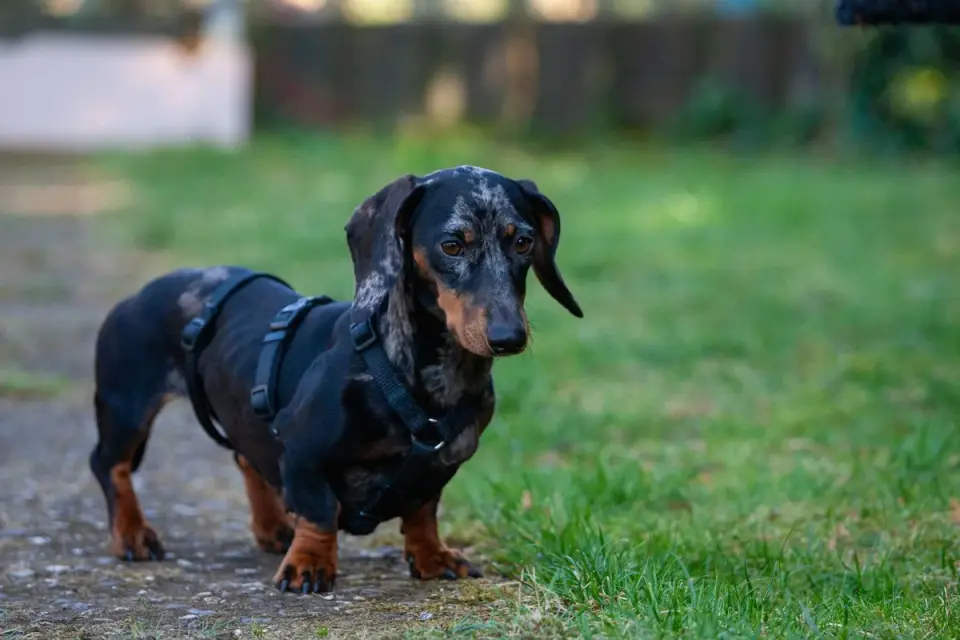
Picture a five-year-old dachshund that yelps once during a normal jump off the couch, then can’t fully bear weight on its back legs twenty minutes later. The owner waits overnight to see if it resolves, reasoning the dog seemed fine that morning. By the next evening the dog is dragging both hind paws and has stopped trying to stand. That delay is the single most common and most costly mistake in this category of case. Acute, painful hind-end weakness in a chondrodystrophic breed — dachshunds, corgis, French bulldogs — is treated as intervertebral disc disease until imaging proves otherwise, and the prognosis tracks tightly with how long the spinal cord has been compressed before decompression. A dog that still has deep pain sensation when it reaches a veterinarian has a meaningfully better surgical outlook than one that has lost it. Waiting to see if a sudden problem resolves on its own is the overreach I’d flag hardest: mechanism explains why the clock matters here, and hoping around it doesn’t change the compression underneath.
The Slow Fade: Degenerative Myelopathy and the Limits of a DNA Test
Degenerative myelopathy is the other end of the timeline — a progressive, painless disease of the spinal cord that typically starts after age eight and begins as subtle knuckling of a rear paw or dragged toenails before advancing to full hind-limb paralysis, according to Cornell University College of Veterinary Medicine’s overview of the disease. It’s associated with a mutation in the SOD1 gene, and breeds like German Shepherds, Boxers, Corgis, and Rhodesian Ridgebacks carry elevated rates. Here’s the overreach worth naming directly: a positive genetic test result is not a diagnosis. Two copies of the mutation raise risk; they don’t guarantee the disease will ever show up, and a clinical diagnosis still requires ruling out compressive, orthopedic, and metabolic causes first, since degenerative myelopathy has no definitive antemortem test of its own. I stay skeptical of owners being told a DNA panel settled the question — it narrowed it.
The Fast Break: Disc Disease and the Window That Actually Matters
Intervertebral disc disease works differently in mechanism and in urgency. When a disc bulges or ruptures, it compresses the spinal cord directly, and the resulting signs — dragging hind paws, knuckling, weak or wobbly rear-leg gait, and sometimes sudden pain followed immediately by difficulty standing — can progress from mild to complete paralysis within hours, per Cornell’s overview of intervertebral disc disease. The Merck Veterinary Manual’s summary of disorders of the spinal column and cord in dogs notes that hind-limb dysfunction, tail weakness, incontinence, and pain on palpation of the lower back are the pattern to watch for, typically starting between three and seven years of age — younger than the typical degenerative myelopathy patient, which is itself a useful sorting clue.
Not every hind-leg paralysis is spinal in origin, though. The Manual’s entry on leg paralysis in dogs points out that paralysis limited to one hind leg is often a nerve-root or lumbosacral plexus injury rather than a disc problem, and that severe electrolyte disturbances, hypoglycemia, tick-borne disease, and certain toxins can all produce generalized limb weakness that has nothing to do with the spine at all. This is why a neurologic exam — reflexes, proprioception, pain response — comes before imaging, not after: it tells you which system to image in the first place.
The Orthopedic Look-Alikes: Hip, Knee, and Simple Old Joints
Consider a Labrador that starts having trouble getting up after naps, slips slightly on hardwood floors, and seems stiffer on cold mornings. No knuckling, no dragged nails, reflexes intact. That picture points away from the spinal cord and toward the hips, knees, or generalized osteoarthritis — a mechanical and orthopedic problem rather than a neurologic one, even though it can look like weakness to an owner watching from across the room. Bilateral hip dysplasia, cranial cruciate disease, and simple degenerative joint disease are common enough in large-breed seniors that they should be on the list before anything more dramatic. Our piece on cold weather and senior-dog stiffness walks through how to tell ordinary joint stiffness from a genuine flare, and it’s worth reading side by side with this one if the gait change tracks with temperature rather than time of day.
Where Supplements Fit, and Where the Marketing Outruns the Data
Once the true cause is identified — surgical decompression for a herniated disc, physical rehabilitation for degenerative myelopathy, joint management for osteoarthritis — supplements can play a supporting role, and it’s worth being precise about what “supporting” means. Joint-support ingredients and general cellular-health antioxidants can help maintain comfort and mobility as part of a broader plan; our guide to whether fish oil is safe for dogs long term covers one of the better-studied options. None of these products treats a compressed spinal cord or halts degenerative myelopathy, and I’d separate that clearly: supporting normal cellular or joint function is a different claim than treating neurologic disease, and conflating the two is exactly the kind of overreach worth flagging out loud. For dogs whose energy and mobility have quietly declined around the same age degenerative myelopathy typically appears, our article on NAD+ precursor chews for a dog whose energy dropped after turning eight is a useful next stop, with the same caveat: energy support is not a substitute for ruling out a spinal cause first.
Building the Next 72 Hours
Start with the checklist at the top of this piece and be honest about the timeline — it’s genuinely the most informative single fact you have. Sudden weakness with pain gets a same-day exam, full stop, because the window for a good outcome in disc disease narrows by the hour. Slow, painless decline over weeks buys time for a proper neurologic and orthopedic workup rather than a guess. Whichever direction this goes, the plan that follows should be built by a veterinarian who has actually examined the dog, not backfilled from a symptom list — mine included.
Frequently asked questions
Is hind leg weakness in dogs always a spinal problem?
No. It's the most common source, but hip or knee osteoarthritis, peripheral neuropathy, and systemic issues like severe electrolyte imbalance or low blood sugar can all produce the same gait. A veterinary neurologic and orthopedic exam is what actually sorts these apart.
Can a DNA test confirm degenerative myelopathy?
It confirms genetic risk, not disease. Many dogs carrying two copies of the SOD1 mutation never develop clinical signs, and the diagnosis is still made by ruling out other spinal and orthopedic causes, per Cornell's Riney Canine Health Center.
How fast can hind leg weakness progress in a dog with disc disease?
Fast enough to matter. Some dogs go from mild wobbliness to complete loss of deep pain sensation within hours, which is why sudden weakness with pain is treated as an emergency rather than watched overnight.
Do joint or NAD+ supplements help with hind leg weakness?
They may support general cellular or joint health as part of a broader plan, but none of them treats degenerative myelopathy, disc disease, or nerve compression. Framing matters here: supporting normal function is not the same claim as treating a neurologic disease.
Sources
- Degenerative myelopathy — Cornell University College of Veterinary Medicine
- Intervertebral disc disease — Cornell University College of Veterinary Medicine
- Disorders of the Spinal Column and Cord in Dogs — Merck Veterinary Manual
- Leg Paralysis in Dogs — Merck Veterinary Manual