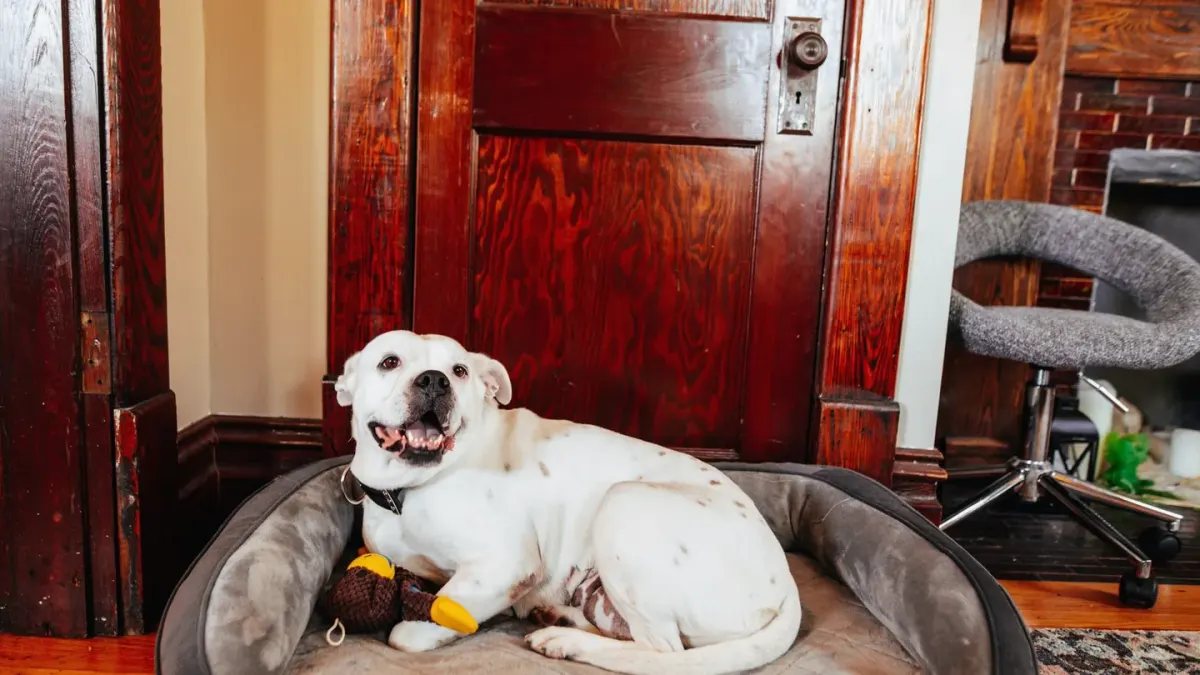
Jane first noticed the change when Gioia, her 9-year-old spayed female Pit Bull Terrier in El Paso, Texas, needed two tries to rise from her bed and paused for about ten seconds at the bottom of three porch steps.
That pause matters more than a single slow day. A home check cannot diagnose arthritis or neurologic disease, and that limit is the point. What it can do is record function in consistent terms a veterinarian can use.
Why does a normal walk often look fine?
Many senior dogs move well once warmed up. Stiffness shows on transitions — rising after rest, the first five steps in the morning, a tight turn in a hallway, a sit-to-stand on a slick floor. Watching only a straight walk misses those moments.
American Animal Hospital Association guidance frames mobility pain as a change in daily function, not a single sign. Licking a joint, lagging on a known route, or avoiding a couch that was once easy counts. The exam still decides the cause. What the evidence does not yet show is a home score that can separate joint pain from weakness or early cognitive change.
What should a seven-day home check include?
Pick the same time, surface, and distance. A 20-foot hallway on a non-slip runner works for most houses. Film from the side when it is safe, then log the same five points each day.
Rise from rest. Count attempts and note forelimb versus hind-limb effort. Walk and turn. Note short steps, wide turns, toe scuffs, or head bob. Stairs and thresholds. Record hesitation, bunny-hopping, or carrying of one limb up three steps. Sit and lie down. Note circling, flopping to one side, or refusal to sit square. Rest and recovery. Note panting, shifting, or time to settle after a short outing.
A validated owner questionnaire can keep wording steady. The canine brief pain inventory described by the National Library of Medicine asks owners to rate pain severity and interference with walking, rising, and play. It does not diagnose, but it gives the clinic a number to track across visits.
Cold mornings can sharpen the picture. For context on temperature and stiffness, see Does Cold Weather Really Make a Senior Dog Stiffer and Slower? Sleep change can also alter daytime movement, which What Sleep-Wake Cycle Reversal Is in Senior Dogs explains in plain terms.
When do home notes become a veterinary visit?
Call promptly for non-weight-bearing lameness, sudden hind-limb weakness, crying on handling, loss of house training tied to mobility, or a fall that does not resolve within a day. For gradual change, bring a one-page log: date, surface, distance, attempts to rise, stair behavior, and any change in appetite, weight, or sleep.
Keep claims narrow. Supplements that support cellular health, including NAD+ precursors and antioxidants, do not restore joint structure on the basis of a home check, and background on age-related inflammation is covered in What Is Inflammaging in Senior Dogs? A Plain-Spoken Look at the Science. If handling food or chews is hard for a stiff dog, Can You Crush a Longevity Chew and Sprinkle It on Senior Dog Food? lays out the trade-offs.
The call is simple. Track transitions for seven days in fixed terms, then let the exam assign meaning.
Frequently asked questions
How often should I repeat a senior dog mobility check?
Repeat the same 5-point check daily for one week when you notice change, then monthly if stable. Bring the log to each senior visit.
Can video replace an orthopedic exam?
No. Side-view video of rising, walking, and stairs helps your veterinarian localize the problem, but palpation, range of motion, and neurologic testing still require an exam.
Sources
- 2022 AAHA Pain Management Guidelines for Dogs and Cats — American Animal Hospital Association
- Development and psychometric testing of the canine brief pain inventory — National Library of Medicine