On this page
Most owners think the sound tells them everything. A growl means trouble, a yelp means someone got hurt, a snarl means separate them now. In my experience the sound is actually the least reliable part of the whole exchange — dogs growl in play constantly, and a yelp during a wrestling match is often just a paw landing wrong, not an injury. What tells you more is the rhythm: how often the dogs stop, whether they swap who’s on top, and what happens in the three seconds after one of them yelps.
I had a client bring in her nine-month-old Australian Shepherd, Remy, about forty pounds, after a dog-park session that “looked like it was about to turn into a fight.” She’d pulled him out mid-play, leash clipped on in under two seconds, both dogs still mid-stride. When we talked through it, every marker she described — the open mouths, the exaggerated bouncing, the fact that the other dog kept coming back for more after being pinned — pointed to play, not conflict. What had actually spooked her was the noise, a higher-pitched growl she’d never heard Remy make before. That’s common. Adolescent dogs experiment with vocalizations the same way puppies experiment with bite pressure, and it rarely means what it sounds like.
The Five Signals That Actually Separate Play From a Fight
Before getting into the myths, here’s the checklist I actually use in the exam room and at the park. None of these is decisive alone — you’re looking for the pattern.
- Self-handicapping. A bigger or stronger dog holds back — softer bites, letting the smaller dog “win” a chase, rolling onto its back voluntarily. Real aggression doesn’t do this.
- Role reversal. Play flips who’s chasing, who’s on top, who’s pinned. A dog that’s actually being targeted doesn’t get a turn on top.
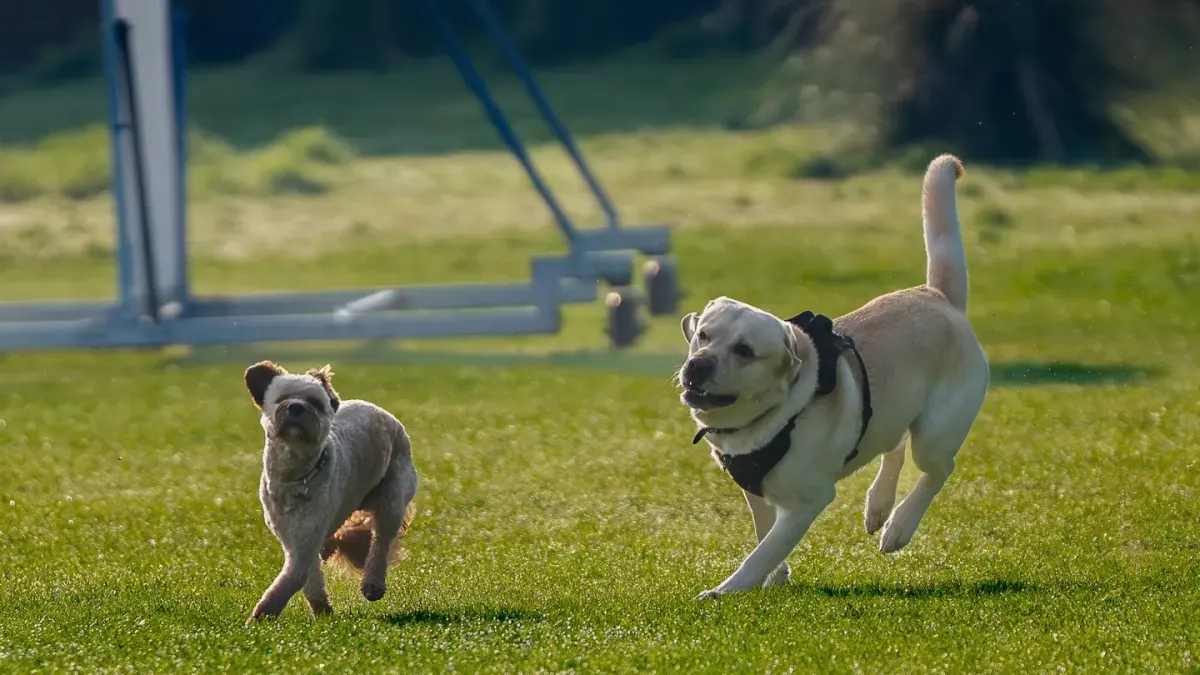
- Loose, bouncy body language. Play involves big, floppy movements — bouncing front legs, a relaxed wagging tail at mid-height, an open, loose mouth. Fights involve stiff, coiled bodies and a fixed stare.
- Pause-and-resume. Dogs playing will stop, shake off, sometimes sniff the ground, and then dive back in within a few seconds. That reset almost never happens in a real conflict — the tension doesn’t dissolve, it escalates.
- Consent checks. A dog that backs off, then approaches again with a play bow (front legs flat, rear up) is checking whether the other dog wants to keep going. You rarely see that gesture from a dog with hostile intent.
The Myth: Growling and Bared Teeth Always Mean Trouble
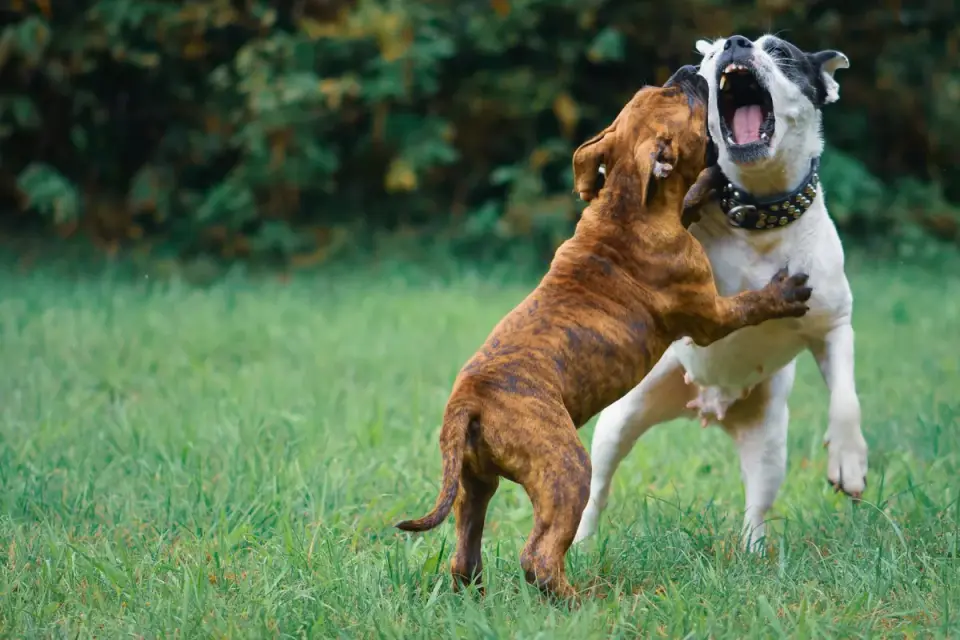
This is the one I correct most often. Growling is a normal part of rough play — it’s arousal, not necessarily aggression. Same with bared teeth during open-mouth wrestling; a “play face” often shows teeth without any of the muzzle tension you’d see in a real warning. The dogs I worry about are the quiet ones: a stiff, closed-mouth stare with no vocalization at all is a far worse sign than a noisy scuffle. Volume is a poor predictor. Stillness is not.
Reading Body Weight, Pace, and Who Controls the Distance
Watch where the weight sits. A dog leaning its full body weight onto another, pinning it and holding rather than releasing, is behaving differently than a dog that play-pins and then springs off. Watch pace, too — real fights tend to be fast, low, and direct, with almost no lateral movement, while play arcs and circles, full of exaggerated changes in direction that serve no purpose except keeping the game going. And watch who’s controlling the distance. In play, both dogs regulate the space between them, closing and opening it by choice. In a fight, one dog is trying to close the distance and the other is trying to open it, and neither gets to choose freely.
When Play Tips Into Something Real
Play can turn. It usually happens with an over-aroused dog that stops checking in, a size or strength mismatch where one dog can no longer escape, or a dog carrying pain that gets bumped the wrong way and reacts more sharply than the moment calls for. If you see a dog trying repeatedly to leave and being followed and re-engaged anyway, that’s your signal to step in — not because the noise got louder, but because consent stopped being mutual. If your own dog seems to growl or snap in situations that don’t look like play at all, including everyday handling, it’s worth reading our guide on why dogs growl when petted, since some of the same misread signals show up at home, not just at the park.
I once worked with an eleven-year-old Labrador named Otis, sixty-eight pounds, who’d played happily with the same neighbor’s dog for years and then, one October afternoon, suddenly snapped at her mid-chase. Nothing about the other dog had changed. What had changed was Otis — arthritis had crept into his hips over the summer, and being bumped from behind at a dead run had genuinely hurt him. His owner assumed the friendship had soured. It hadn’t. He’d become the dog described in our piece on cold weather and senior stiffness — slower to rise, stiffer after rest — and pain was doing the talking, not temperament. Once we managed his mobility, the play resumed exactly as it had been. The lesson stuck with me: a sudden change in an established relationship is a body-condition question first, a behavior question second.
Where Calming Support Fits, and Where It Doesn’t
Calming ingredients have a real, if modest, place for dogs that are chronically over-aroused, reactive at introductions, or slow to settle after a big play session — they are not a fix for a genuine fight risk, and they don’t replace supervision or management. Chamomile has traditional use for relaxation, though for most species — dogs included — the evidence is still mainly preclinical or drawn from traditional use rather than robust clinical trials, according to a review in Biomedicines. KSM-66 ashwagandha has more clinical backing in humans: a systematic review in Cureus found a moderate positive effect on stress reduction and cognitive performance across multiple randomized trials. L-theanine’s evidence is more mixed than marketing suggests — a large meta-analysis in Molecular Psychiatry found a meaningful anxiety effect in only one trial of psychotic anxiety, at 400 mg/day over eight weeks, with most other outcomes showing no clear signal. None of this replaces reading the dog in front of you. If you’re weighing whether a calming chew belongs in a senior dog’s routine at all, our piece on crushing a longevity chew into senior food covers how to introduce supplements without upsetting an existing feeding routine.
The Bottom Line
If I had to leave you with one habit, it’s this: stop listening for the moment it looks scary and start watching for the moment it doesn’t reset. Play interrupts itself and starts again. A fight doesn’t. Everything else — the noise, the teeth, the size mismatch — is secondary to that one pattern, and it’s the one thing I ask every worried owner to watch for before they intervene.
The last dog I saw for this exact question was a rescue, a lean 35-pound mixed breed named Junie, maybe two years old, who’d only been in her new home five weeks. Her owner called mid-walk, convinced Junie was about to be attacked by a neighbor’s dog they’d met at the same corner three days running. I asked her to describe exactly what she saw: bouncy approach, a play bow from the other dog, brief pinning that Junie squirmed out of and then walked back into. That’s not a fight building. That’s two dogs figuring out how much pressure the other one can take, which is exactly what dogs are supposed to do with a new playmate they intend to see again. She let the walk continue. They’ve met at that corner most mornings since.
Frequently asked questions
Is growling always a bad sign between two dogs?
No. Growling is a normal part of rough play and shows up constantly in healthy interactions — it reflects arousal, not necessarily hostility. A stiff, silent stare is a more concerning sign than a noisy wrestling match.
What's the single fastest way to tell play from a fight?
Watch whether the dogs pause and voluntarily re-engage. Play interrupts itself and resumes within seconds; a real conflict escalates instead of resetting.
My older dog suddenly snapped at a dog he's always played with — why?
A sudden change in an established play relationship is often a pain or mobility issue rather than a personality shift, especially in senior dogs who've gotten stiffer or slower without an obvious flare-up.
Sources
- Wild Flora Species from Romania with Anxiolytic and Antidepressant Potential: A Global Perspective — Biomedicines
- Ashwagandha as an Adaptogenic Herb: A Comprehensive Review of Immunological and Neurological Effects — Cureus
- Cognitive and affective effects of L-Theanine: a systematic review and meta-analysis of 31 randomized trials — Molecular Psychiatry